
I just finished transplanting most of my sprouts to 3-gallon pots, where they will stay for the next month. Planting day is June 1. The next significant day will be in ten days, when sexing begins.
While doing the delicate transplanting, I lament over the waste of good soil, only in pursuit of finding males to throw away.
(And unless you are growing indoors for seeds, please get rid of your male or hermaphrodite plants. Everyone in your neighborhood has the right to a female only grow.)
By the way, did you know that commercial cannabis farms have to be many miles apart, in order to prevent accidental male contamination? So please, carefully wrap that bad boy and throw him away. Be a mindful cannabis grower, and try again.
There have been years that were more egregious than others for me, in terms of wasting soil. The year of the infamous Sack Festival, when I had 63 out of 70 seeds turn male, I could not believe how many bags of good soil I had to use in order to find nothing but pollen sacks. It cost nearly $200 for that soil to showcase the throwaways.
Of course, I end up putting the soil somewhere it can be used, but I’m currently not really short on soil in my growing mediums. Too much soil causes spillage. Too much spillage in my beds and other plants start growing between the beds. Sometimes, that’s ok, if it’s a beneficial plant, like borage, but other plants have to be constantly pulled. When our plants get large, with training, they tend to expand well into the aisles.
Which reminds me of an interesting growing tip that I’ve observed over the years.
I grow in the following method: From germination in a tissue to a small cup with soil, to a 3 gallon pot, and then finally, my raised beds. This progression has allowed me to maximize my growing spaces.
Over the years, I have received starts from other growers. Occasionally, those starts were in 3-gallon pots. More often, they were in smaller, and more narrow pots. The plants brought to me in pots smaller than 3-gallon have never grown to be as large as the plants that I grew in 3-gallon pots before planting. They would grow tall, but remain relatively narrow, compared to the plants that got to grow in 3-gallon pots.
So, what seems to be happening is that if your plant starts in a taller and more narrow container, those roots will not expand as far to the sides in the final growing medium. The plant will not grow with as much width, no matter how much training. Here is some information to bear this out.
We have grown the West Marin Mystery from seeds that I have. We have also grown that cultivar from starts given to me by the breeder, in more narrow pots. The eventual yields of the plants brought to us in narrow pots have both been a little over a pound each. The one time we grew that strain from seed ourselves, having transplanted the seed from a 3-gallon pot, we yielded over 2.5 pounds. Yes, other factors play a part in this, but still . . . that’s a huge disparity. And–it’s something we could confirm visually. The more narrow the transitional pot, the more narrow the final plant. And whereas I view this as not maximizing my grow, another grower could view this limiting step, almost a pre-training, as being part of how they control the size of their plant in their yard.
I don’t have a full picture of a smaller West Marin Mystery, but the 2.5 pound plant we grew from seed looked like this:
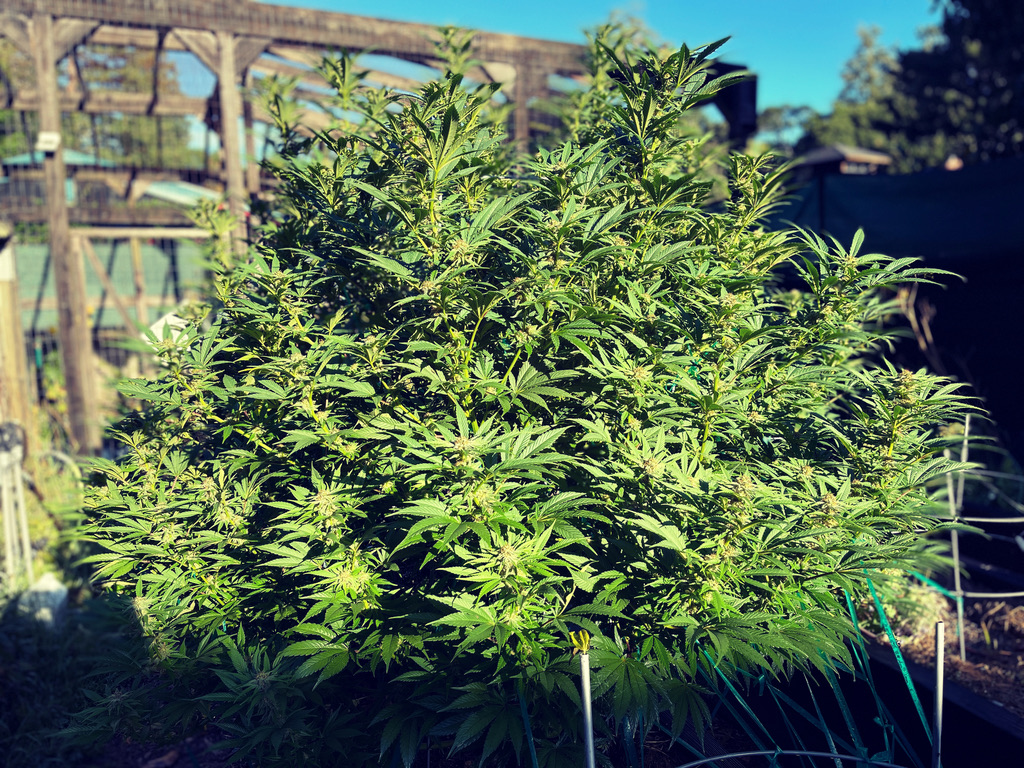
So . . . if you want to grow large plants, every step of the way matters. Don’t short circuit your seed by putting her in a smaller pot for those weeks prior to planting outside.
But, if you are growing multiple plants and width is an issue in your growing space, you should consider using the taller, thinner pot for the intermediate step. It would serve to pre-train your plant to better remain within a confined space. It would also limit the amount of pruning you’d have to do to discourage the plants from touching one another.

The regular seeds are now transplanted. The feminized began sprouting today.

Lights are on late in the cottage these days.
The cottage is humming right now. Transplants are in 3-gallon pots. Feminized seeds are just beginning to sprout, one month from planting outside. Two five-gallon compost teas are brewing in the same room as the starts. Lights are on, air conditioning is on, oscillating fans are on, the dehumidifier is on, and a heater goes on at night if it drops below 70 degrees. It is happening in the cottage. During this period, we nervously await the next electricity bill.
Currently, I have 17 regular seeds transplanted into 3-gallon pots. There are nine Royal Kush, six West Marin Mystery, and only two Fruitcake. Five of her six seeds sprouted, but three of them never took to the soil. I’m disappointed, but it happens, and if I don’t get one this year, I’ll try again next year. Sexing will commence in ten days. Meanwhile, I started my feminized seeds this morning. I usually keep the feminized seed starts all together and the regular seed starts on another table. I now try to only start about 30-40 regular seeds per year, and fill in with feminized. Thankfully, since the Sack Festival, seed sexing has probably been closer to 50/50.
In getting the feminized seeds going, I took a gander at the seed library and realize that next year’s grow is already in house. Don’t have to buy anything. That’s a nice feeling in the home dispensary. A lot of next year’s grow is coming from extra feminized seeds I received when I ordered something else, LOL. Thanks for the free Purple Punch, Apple Crumble and Roze, among others.
The tea that is brewing is not for cannabis, which do not get their first sips of tea until they are four weeks old. The roots are not developed enough prior to that point to be hit with complex sugars. The tea I’ve got going right now is purely for all the vegetable starts we have in our beds. It’s a high nitrogen, high vegetative growing tea. It’s probably the only time I’ll use any of my collected guano this year. I’ll save it and gather another year’s worth of guano this year and use it heavily next year. I won’t have to buy fish or any fertilizer.
We are absolutely thrilled to have bats returning from winter to the various houses we have on the property to capture their guano. Had never collected guano as early as April from them before. After two straight rainy winters, it’s looking like a banner year for insects, and that means happy bats.
Having planted fish in every bed last winter, I’m not even that interested in using guano this year. It will be very important for next season’s grow. However, I am interested in capturing this year’s guano for future use. In the years I don’t use fish for fertilizing, California Brown Bat guano has become one of my favorite nitrogen regenerators for the beds. I have an almost full half-gallon jar of guano from last year. So this year’s guano will probably not be used for some time.
Having a backlog of guano is advantageous for any grower’s toolbox. It’s important to emphasize that this guano is free. Put up a house and they will come. All you have to do to make it viable is to dry the guano properly, to kill any “live” bacteria in the scat.
Given how much it costs to buy nitrogen rich soil, wouldn’t it make sense for some of you to start putting bat houses up where you live? It may take them a while to find you, but once they do, they will return. They have babies in that house, so the babies come back, too. And at night, they control your insect population; especially the mosquitos. It’s a win/win.
I tell outdoor growers all the time to put up bat houses. The guano itself is gold and would probably get a NPK rating of 8-0-0, or maybe 8-1-1. Guano is also a vital part of building the sustainable microbiology of your soil.
But in yet another lesson of I’m Not as Slick as I Think, I was humbled a few days ago when I peeked at the poop our bats had been dropping onto the screen below their house. A couple of weeks ago, I went up there and saw the growing amount of guano being captured. We clearly have at least 10 bats in that house currently and that number will grow as they have babies over the summer, and other bats join them in their rustic little house. I don’t ever remember having this much guano in any tray at the end of April. Thinking this could be one hell of a haul, guano wise, this year.

I was going to let it accumulate until the plants are out of the cottage and into the beds. Guano is rather fragrant the first few days of drying, so I didn’t want it in the cottage yet. But nature had other ideas for the guano. To the surprise of no one, spring winds have suddenly risen and every afternoon for the last week, up to 25 mph.
So the last time I went to peek at the guano, I realized a flaw in our design. The screen needs a higher wall to guard against the wind. That lovely guano had been blown to I have no idea where, except someplace that is now fertilized.

Alas, accumulation begins again. I will endeavor to be more mindful in my collection.

One month from planting.
Hey Friends: If you’d like to support jeffreyhickeyblogs.com, please feel free to donate to PayPal @jeffreydhickey.
Disclaimer: The majority of the links in jeffreyhickeyblogs.com posts are affiliate program links. This means that (most of the time) when you purchase a product linked from my site, I receive a commission.
 Jeffrey Hickey Writes Blogs
Leave a comment