
After 5:00 pm, the only light they get is through the trees.
Every year, I like to do something, at least one thing, that is experimental. It’s part of my constant evolution as a grower. It’s the only way I know how to test for something better. In most ways, I’m settled as a grower. I buy the same molasses (Hybrix), the same liquid fertilizers (Pura Vida Grow and Pura Vida Bloom), I use only sea based fertilizer for my beds, including SEA-90. I’ve settled on Pro-Farm products for both my IPM (integrated pest management) program, and for my fungicides. I use automated systems for indoor and outdoor lights, air conditioning, and heating, and a battery powered foliar sprayer that I recharge once a month during the grow.
I do most of my work between the hours of 5-8 in the morning. I work classic farming hours, and I am like clockwork on virtually every activity. I don’t need an alarm, nor any reminder of what I need to do from one day to the next.
But every year, I try something new, something different, something intentional. It’s one of the best ways to learn. It goes hand in hand with making mistakes, which I do all the time (and try to share with you). It’s something I do mindfully, and usually, on one plant only, to see if it works. I don’t want to do an experiment on the entire crop. When you’re an outdoor only grower, you really can’t risk it all. We only get one shot a year to grow. So I do experiments on designated plants. Experimentation is how I discovered how little water I actually need to grow effectively.
This year, I’m doing the following:
- I’m seeing if lavender alone can protect cannabis plants from deer.

Here they are, with aging lavender on either side and a tomato cage frame around. One small plant and one single flower. I was not going to put a potentially large plant in that spot unless I felt confident. So–within the experiment, no large plant was risked. Both of these smaller plants were weak in the cottage and would have been tossed. But Bee wanted to save them, and this seemed like a noble place for them to live their lives. So far, so good.
For many years, I have instructed students that lavender is a deer deterrent for cannabis plants. As you see, I have lavender planted around my bed fence. But this year, I decided to put two plants outside our bed fence, completely unprotected, next to the lavender. We have an active deer community on our property and surrounding us. We have babies born here every year and grazing galore occurs while deer nibble away at things they are welcome to have. They have come within eight feet of the little plants. There is sometimes a scat line that marks where they’ve stopped. All they would have to do is walk over and eat our little plants to the ground. We know of cannabis plants eaten to the ground by deer at other farms. To date, our little plants have not been nibbled. And they are both starting to flower, so it is unlikely that a deer will bother the odorous developing plants now. I’m happy about that, because I’m enjoying watching Fruitcake develop purple flowers.

- We’re growing directly in our native soil for the first time.
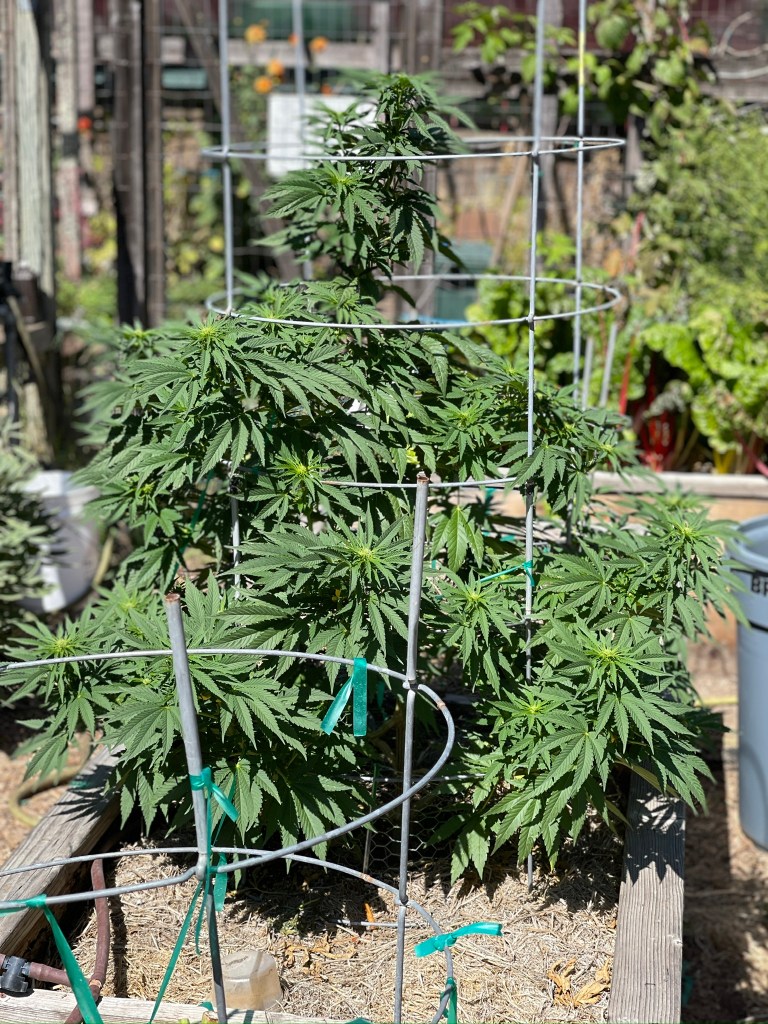
I’ve never grown directly into native soil here. In addition to these two small plants, I am growing a White CBG and an ACDC in our aviary. I’m looking for a viable spot to plant directly in the ground. Both of the CBG plants had stressful transplants and immediately started to flower (both feminized seeds). I allowed the CBG to flower (she’s the plant from last week’s blog that had flowers in stages of development that were six weeks apart. But I stripped the ACDC, because she would have been a giant, and I wanted to take greater advantage of our native soli with one of the two plants in the aviary. I have done this to many plants over the years. She did not enjoy the stripping, and pouted a few days, but when she began to emerge again about a week and a half later, she grew with an energy and vigor that to my eyes is stronger than any other stripped plant I’ve ever had. What she is doing right now, is convincing me that a feminized seed will go into this spot next year, much earlier, and she’ll be allowed to grow 100% as nature intended. She’ll go directly into the ground and take off. Here’s a few pics of her through the vegging process:


This plant is rebounding with a passion. Her commitment to veg growth allowed Bee to sufficiently train her to the sides. This allowed me to go inside for pruning. She is finally flowering now, and will be a later October harvest. We’ve had ruderalis to harvest in November, so we’re grateful she has turned now. I expect these flowers to be exceptionally strong CBD medicine. Due to her vigor, and her response to the native soil, I am expecting more than a pound, which would be an impressive yield from a plant that tried to flower early.
The only downside potential is we might have to dig some stakes into the ground to support the flowers to come. We don’t want them bending to the ground. I know, such a problem.
Regardless, this is a potential new site for growing plants. Our native soil is incredibly rich. On this particular spot, Bee constructed the grow zone from ground patrolled and infused for twenty years by ducks, so it was already extremely fertile. They added a large chunk of raw mycorrhizae deep into the soil. Over this next winter, I will pour several brewed teas rich in bat guano. We intend for this spot to have a feminized seed grow next year, something with explosive growth potential. Perhaps, as Bee speculated recently, something with a little more sativa. Something that we could allow to grow very tall. Come back next year and find out.
The last plant growing in native soil is one I alluded to in the previous blog. This is the White CBG and she is an early flowering plant growing with vigor and the single oddest characteristics that I’ve ever seen on any cannabis or hemp plant. This is the plant with some flowers ready to harvest a few days ago, more ready by Wednesday this week, and finally, an entire bough that grew vegetatively while the rest of the plant flowered. This final bough has about a month remaining before harvest. I’m doing staged harvests right now, and I’ve done them previously, but never with as dramatic a difference in harvest dates as this plant.

A CBG flower soon to be harvested.

Flowers soon to be harvested on the right and an entire bough on the left that needs another month. This started from the bottom branch on this plant. This part of the plant grew vegetatively while the majority of the plant flowered. My head pretty much explodes at the implications.
Oddest plant I’ve ever grown.
But now, I’m going to make a bold prediction. Last year, I grew two White CBG plants, and they grew the entire season. They were my only plants to not flower early. They grew a full five months in beds, and their flowers were rich and fat, though their total yield was rather disappointing. From those two plants, we got a total of 378 grams, around 0.41 pounds per plant, not even half a pound.
This year, we have two more White CBG growing, one in native soil and one in bed 19. They both flowered almost immediately after transplanting outside. Neither of my plants this year will grow the full cycle. They are early flowering plants, almost like autoflowers.
Here is my prediction: The plants this year are each going to yield more than the plants last year. I believe that both of my early flower hemp plants will yield more than last year’s full season grown hemp plants. It will take some time for me to hypothesize the wherefore and why of this potentially unique circumstance. But that is my prediction.
3. Growing a feminized seed directly into a bed.
Last, but certainly not least, there is the Royal Kush in bed 18. This is the feminized seed I planted (somewhat in anger, though mindfully, with crown up), after a regular Royal Kush plant turned male. This simple exercise has the chance to transform my grow next year. By planting more feminized seeds directly into the growing mediums, I will save in soil costs, and I will spare those cultivars the transplanting process. She won’t be as large as if she’d grown the entire season, but she is showing me the way.


Over the years, I’ve had successful experiments, like learning to use significantly less water. I’ve also had spectacular failures, like the second year, when I attempted to grow 18 plants outside without using BT.
Hahahaha, what a hoot that was. We lost approximately 40% of that entire crop to mold. We only saved what we got because we eventually had to spray BT, to save the crop. I can laugh about it now, and I do, but it took a long time getting my head and heart to this happy place.

Here comes the bottle brush.
Hey Friends: If you’d like to support jeffreyhickeyblogs.com, please feel free to donate to PayPal @jeffreydhickey.
Disclaimer: The majority of the links in jeffreyhickeyblogs.com posts are affiliate program links. This means that (most of the time) when you purchase a product linked from my site, I receive a commission.
 Jeffrey Hickey Writes Blogs
Leave a comment