
Purple Hindu Kush–40 days.
I am getting to the “last time” point in the summer. It will shortly be the last time for compost teas and foliar sprays. The last time my cannabis or hemp plants received pure water was around the first of August. My tomato plants haven’t been watered since the end of June.
The final few weeks of growing, I generally try to use as little of anything as possible. From about three weeks until harvest, for every plant, I try not to give them any more tea or foliar sprays. I try allowing each plant the opportunity to finish on their own. My understanding is that by stopping everything three weeks prior, I’m allowing the full flavor and odor profile to completely emerge. Honestly, with only three weeks remaining, these plants don’t need any more pushing. Everything they need has been poured into the soil over the course of the summer. I am also of the belief that the plants are appreciative of being allowed to finish without another soaking of anything other than a little rain.
We are possibly expecting a little rain this week. Not enough to worry me, or cause an early harvest. Just a few hundredths, and maybe a tenth or two. It will be enough to give the plants a little 7.0 pH boost. It won’t be enough, I don’t think, to activate the annual explosion of ground based termites.
I inspect each plant multiple times a day. I’m looking specifically for any sign of worms or mold. We’re also looking for debris (leaves, feathers, scat) that has landed and gotten stuck to a flower that could turn to mold. When Bee is here, they immediately do the same thing.
Bee commented the other day how much this last phase of the grow has changed since we started nine years ago. Those first few years, especially year two, almost burned us out on growing. We remember spending 2-3 hours every day snipping and bagging powdery mildew leaves, and cutting down entire buds impacted with botrytis. This was day after day for weeks. A beautiful garden got significantly whittled.

2017–the year we tried and failed to make friends with white moth families.


We don’t get explosions of botrytis like this anymore. This level of mold stopped as soon as we started using Stargus.
Mind you, we’re still doing the same inspections we’ve always done. The difference is that now, we find occasional problems, but nothing like what we used to face.
If we were not fighting mold, we were constantly fighting powdery mildew. We live in a coastal region with variable humidity, which causes excessive moisture. Excessive moisture brings pathogens to plants, and eventually, mold.
Those first three years were a battle. The second in particular, was somewhat torturous. We had 18 plants that we were trying to grow without BT, and mold was everywhere. We lost 40% of our crop to mold that year. What I needed were real solutions to my problems.
That’s when I was introduced to Marrone Bio Innovations, a small company out of Davis, California. They were making organic solutions to all manner of growing problems. They were originally doing this for wine growers, but the crossover to cannabis was logical and easy. They were eventually purchased and became who they are now: Pro Farm.
The first product I tried of theirs was Regalia, and that is all I’ve used for powdery mildew since. The next year, I told Bee, “I’m going to out-work powdery mildew this year.”
We haven’t had a powdery mildew problem since we started using Regalia.
This made me look harder at other products by Pro Farm, specifically their bio-insecticides. We were having great success with companion plants attracting beneficial insects, but we’d still get some insect damage. Pro Farm has a one-two approach. Two products, sprayed once every other week. The products are Grandevo and Venerate. Between those foliar sprays, and my use of beneficial plants, our insect problem is no more. We still get a few Western Cucumber beetles, but nothing like we used to. We watch the nearby borage become inundated with aphids, but none of them touch our cannabis or veggies.
In fact, we have witnessed on more than one occasion, what happens to aphids when they land on borage. If they stick around too long, they will be herded into a tight cluster and kept prisoner for the remainder of their lives, by ants. This can happen mere inches away from cannabis and the aphids become the slave sugar receptacles for ants. By the end of the growing season, they are black balls of death, where there had once been aphids.
So, the combination of beneficial plants and the Pro Farm bio insecticide program has almost completely eliminated above ground insects from damaging, or even nibbling on my plants.
I also apply these foliar sprays on all my vegetables, with the exact same effect. There will be some insect damage from just before I started the spraying. After that, they grow perfectly.
Soon, I’ll only continue spraying it on the remaining vegetables and produce to harvest, but not the cannabis.
Finally, three years ago, I was introduced to Stargus. I have written about it extensively before, but as I use it another year, I still feel the same sense of wonder that we’re no longer experiencing rampant mold. For an outdoor grower, this product changes everything.
I am now able to prune differently than before. I can allow more to remain on a plant, because the risk of botrytis from being in close proximity to other flowers has been eliminated. Even in tightly clustered kolas, I can run the nozzle of the foliar sprayer up and down the stalks, protecting the flowers, even under close quarters.

The nozzle goes through all of the clusters, so everything gets soaked.
I have my foliar spray nozzle configured to spray to the sides, so I pass that nozzle up and down this tightly clustered Royal Kush. When I separate the stalks (wearing gloves), no mold has been detected, with 20 days left to harvest. It could still happen, but we’re not expecting anything that we can’t handle with tweezers.
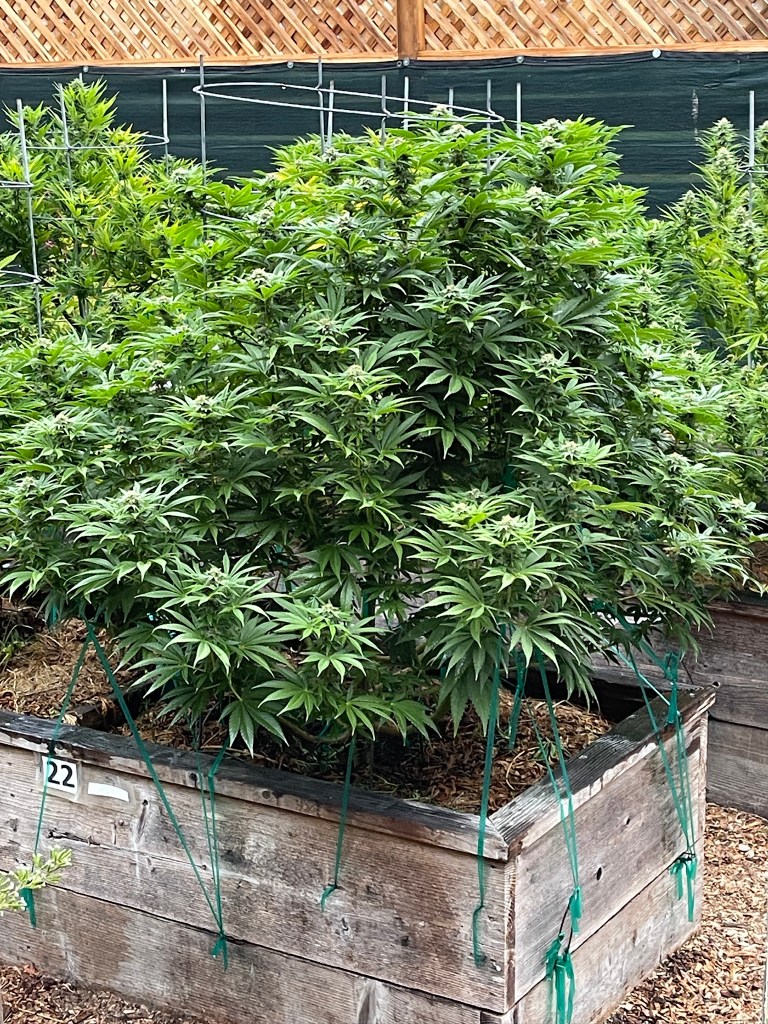
The same can be said about Hindu Kush, a plant not known for being large, but definitely cluttered. While I have pruned her insides, I have also left a lot of flowers within close proximity. I’m expecting them to grow without incident.
In our second year, we had a Granddaddy Purple that was clustered like this, and we cut so much mold off of her, we only harvested 96 grams.
But even Stargus, as amazing as it is, doesn’t need to be applied the entire flowering period. After about a month or five weeks, the flower is basically constructed and protected.
Full disclosure, however: I spray Stargus through the sixth week before stopping.
To be clear, Stargus is what stops, or limits mold on a plant. This is mold caused by external forces, worm scat, a damaged leaf, gnats, other dead insects, or anything susceptible to mold when moisture finds it. Stargus will limit the progress of that mold and make it easier to remove without harming the flower, or leaving any mold residue.
Stargus does not stop systemic mold, which comes from within the plant, like from a spider mite, or earwig, something that leaves scat to mold. When that happens, if you don’t spot it early and eradicate it completely, you’ll have a systemically moldy plant at harvest that you’ll have to throw away in its entirety, immediately. This has happened to us.
So, we’re getting to the tapering off, or stopping point of foliar sprays, which in conjunction with our commitment to beneficial plants and insects, we have come to control our main growing problems. Because of these products, it is nowhere near the grind it used to be.
I am grateful for the tapering off from the daily grind. I’m enjoying the less stressful plant inspections. I remove each tiny piece of debris that I see, with full knowledge that I’m not seeing everything. That’s ok. It’s the looking that I love.
Fall is whispering its arrival, and the backsides of leaves are starting to turn.

Half of my crop got their last compost tea of the year this week. Three weeks to start the harvest.
Hey Friends: If you’d like to support jeffreyhickeyblogs.com, please feel free to donate to PayPal @jeffreydhickey.
Disclaimer: The majority of the links in jeffreyhickeyblogs.com posts are affiliate program links. This means that (most of the time) when you purchase a product linked from my site, I receive a commission.
 Jeffrey Hickey Writes Blogs
Leave a comment