
July is the transitional month. Plants should be vegetatively growing at their full potential. Some plants will grow over an inch a day. But July is also the month where plants begin to transition to flowers.
July is the month where my grow is at its most automated. Every day there is something to do, and most everything can or should be done before the sun touches the plants. Supplemental lighting will remain on through July 21, one full month after Solstice. After that, the lights will go off and the plants will be left to take their growing or flowering cues directly from the sun. Hence, the transition, from vegetative to flowering.
Given that we’re taking away the supplemental lighting ten days before the end of July, it is possible that a few plants will start to flower before the end of the month. But I anticipate most will begin their flowering process the first week of August.
July is the month that the sunset time seems to stay the same for weeks following the summer solstice. Sunrise time is already gaining close to a minute a day, but sunset is still at 8:39. It’s been 8:39 for twelve days.
In the past, I have waited until the third week of July to start any sort of flowering, or bloom formula for the tea. But this year, while the supplemental lights are still on, I’m going to include phosphorus and potassium in the next three teas. I always waited in the past, because I didn’t want the plants to flower early. But early flowering cannabis is not caused by additional nutrition, it’s caused by lack of light. While my plants are still not in danger of flowering, I want to feed them the extra nutrients they’ll need once the flowering begins, because phosphorus and potassium are not just for flowering plants, but are for plants at all stages of growth. That’s why “grow” formulas – heavy in nitrogen – often have lower percentages of both phosphorus and potassium. They are important to plant health.
Given that I am not watering bed 15 anymore, potassium might be of particular importance, since it aids plants in dry or drought situations.
In the past, without supplemental lighting, I never felt safe offering it to my vegetative cannabis when they were all teetering so close to the 12 hour window. But with supplemental lighting, I don’t have that problem. I can safely feed my plants the extra nutrients before they start the flowering process. This can only be good for flower production.
So let’s take a tour of my plants right now, during the peak of their vegetative growth.
Bed 11: Cherry Punch

She’s in full sprint and is thickening up. In another month, I’ll probably need a stool to get all my foliar sprays on her. One of the two tallest tops on her was the top that was severed and then healed itself through honey and plant tape, before resuming growth. Plants can mend tears and breaks if you use enough silica in your teas.
Bed 12: S Thai

Very excited about this small plant. She was the one S Thai I brought from the “Contenders” table in the cottage. She is already larger than the S Thai we grew last year, but was only put in a bed about a week before Solstice. This cultivar does not grow large.. But I think we can coax her into being the largest that she can be.
Bed 13: Royal Kush

This is a very healthy growing plant. She has more inner space than most Royal Kush, which tend to be compact. She will have to be pruned judiciously over the next six weeks to keep that space. She is tall for a Royal Kush, though the other we’re growing is even taller. I anticipate a larger-than-average yield for her. Royal Kush is not typically a large-yielding plant. I wish she were, because she’s such a favorite of mine. I do a lot of writing on Royal Kush.
Bed 14: West Marin Mystery
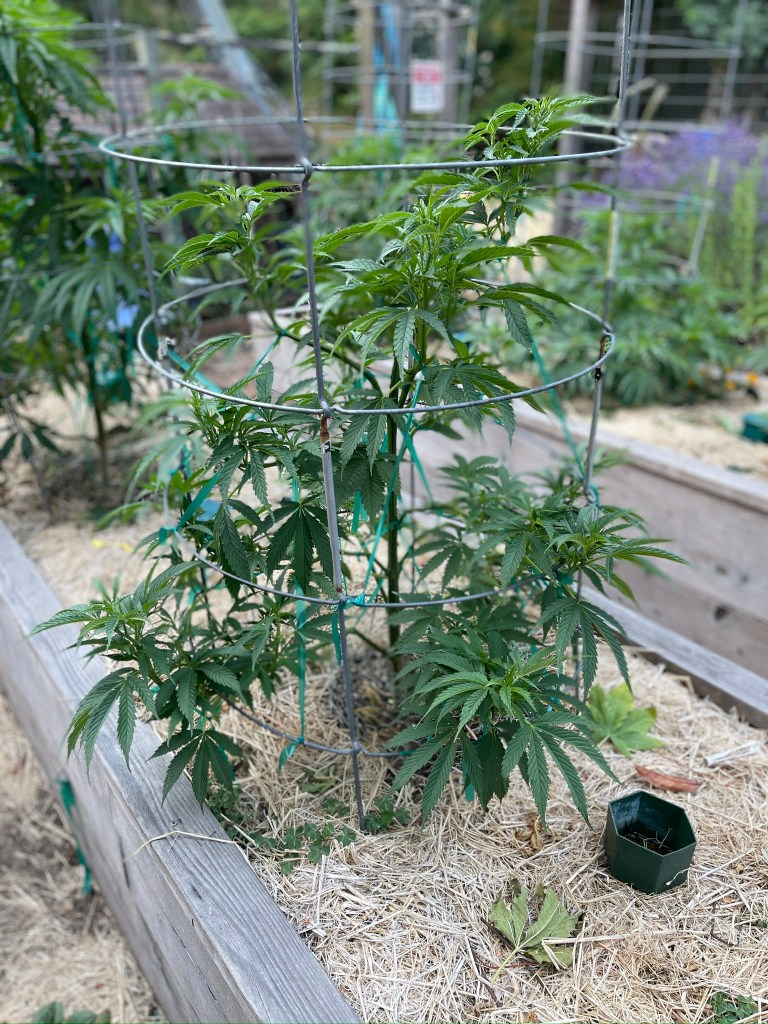
She’s growing up and spacing out. When I first transplanted her, I thought she might be our largest plant, but both Cherry Punch plants far exceed her. She grows similarly to the Royal Kush, which she should, since that cultivar is half of her lineage. But she tends to grow taller and she is starting to spread out. This is one of our all-time favorite cultivars, and she is grown with an acknowledgment toward the breeder, who has been generous with me. This is not a strain available on the market. It’s a local, home-grown strain. Her value, medically speaking, is off the charts. She just makes you feel good. I am blessed to be able to grow her.
Bed 15: Cherry Punch

This is the plant that has not been watered since May 25, so it’s been over a month. She gets her quart of compost tea, but that’s all. She’s the tallest plant in the beds and she’s growing slightly over an inch a day now.
In many ways, this is the “Plant of the Grow” this year. I’m rolling the dice that she’s already part of the mycelium network beneath my beds, and she will grow to completion exactly as nature intends for her. If I see her suffer at all, I’ll pull the plug on my experiment and give her water. But it’s been over a month and she’s growing taller and faster than any plant in my beds.
I have long opined that less water means more growth at my farm, and so far, that is what is happening in bed 15. Stay tuned.
Bed 16: Honey Tsu

Honey Tsu is my lone CBD plant this year, and she has me quite excited. Though she looks small now, she is growing rapidly. She is one of those late growers. She’ll require a lot more inner pruning, but she is building towards some beautiful flower production. The last time we grew her, the flowers were brilliantly thick with medicine. This is a solid, dependable, test-proven, CBD cultivar.
Bed 17: Rośe

Note the air and space on Rośe now, as opposed to when she was planted, and she resembled a sat on toad. She was completely compressed while in the cottage. It has taken a month, but she is finally stretching out. We’ve had a couple of accidents with tops breaking on this plant – in fact, there’s only one true top remaining. But she is growing and expanding at a rapid rate. She will also need ongoing inner trimming to keep her open and moving upward.
Bed 18: Fruitcake

Similar to the other Fruitcake, she is compact and needs consistent inner pruning. But the last two weeks she has begun moving outward, while slowly growing up. The slowness of the veg growth tells me that this plant might have suffered some root stress during the transplant. But she’s rolling now, and I suspect July will be a typical bed 18 month for her. Bed 18 has been our most prolific growing medium. Our two largest plants have grown there, and some of our most memorable flowers.
Bed 19: S Thai

My only disappointment with my bed selection this year is this plant. She was always on the “pretender” table, because she’s not a strong plant. She’s growing okay for what she is, but my regret was that I didn’t put this plant in the 25-gallon bag, and the much larger Apple Crumble in bed 19. Alas . . . it’s all good. She is small and will remain small. She reminds me of the S Thai we grew last year, and that actually gets me excited, because that S Thai was the single most powerful plant – based on terpene percentage – that I’ve ever grown. And the amazing thing about that is she didn’t go into a bed until mid-June, so she didn’t even get a full growing season. That’s why I wanted to grow two S Thai this year. I want to give them both a full growing season, to see how large they can grow, and how powerful they can be. In the case of S Thai, size is irrelevant to quality.
Bed 20: Royal Kush

Even taller than the other relatively tall Royal Kush, this was the feminized version that we put in the beds after about ten days indoors. She has been given the opportunity to grow exactly as her seed was designed. She’s the tallest Royal Kush we’ve grown to date. She’s taller than the West Marin Mystery, which is unusual. She is another beautifully growing plant. All we have to do is prune and not hurt her. Since last year, when we started a Royal Kush seed directly into a bed on May 29, we have looked forward to growing these feminized seeds again. The two we are growing are not disappointing us. But I must note the difference between the two Royal Kush is entirely because one plant came outside early, and one remained in the cottage, compressed into a 3-gallon pot, for five weeks. Turns out that the pot compression isn’t something they can fully overcome in the bed.
Bed 21: Fruitcake

She was the transplant that went deepest into a bed. It took her a couple of weeks to grow out of the gopher cage she was in, but she’s growing well now. She benefited greatly from the inner prune and will need ongoing pruning, too.
It’s interesting, we grew Fruitcake last year and she produced the most beautiful purple buds. We were lucky to get that phenotype. My guts are telling me that neither of the Fruitcakes we’re growing this year are going to be colorful. We’ll see, but these just look different, even at the veg stage. Last year’s plant seemed olive green the entire grow and the contrast between that green and the dark purple was stunning.
Bed 22: Purple Punch
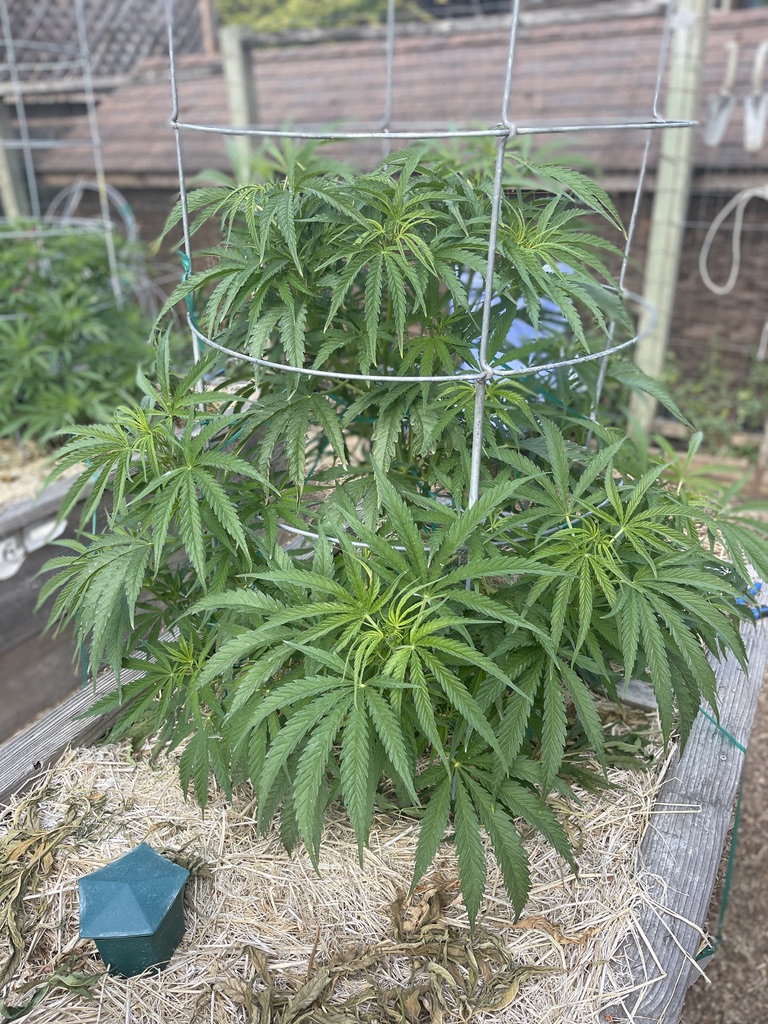
I’m so proud of this girl. She got harassed by aphids when she was small. She looked very unhappy. Then one day, it got warm, and she has been going off ever since. What at first glance seemed like a smallish plant, is quickly demonstrating that she is anything but small.
In fact, I must acknowledge that all the Punch plants I’m growing this year are vigorous growers. She requires proactive pruning, because she’s expanding quickly.
Experiment Plant Outside the Aviary: Apple Crumble

So far, so good on this plant we have growing outside our beds, which means it is completely exposed to animal interaction. Western Cucumber Beetles are getting their fill of this plant, but that is the only pest or animal to sample her so far. Right now is the peak time that deer could eat this plant. But our lavender is also at peak. There isn’t even a nearby scat line. Deer are staying away, despite having had multiple babies born on the property. There are still weeks to go , but my guess is nothing serious is going to harm this plant. And once she starts to flower, the smell will keep the deer away.
And Finally, Last and almost certainly Least: Aviary AK47 Extra

She’ll be the first to flower, I’m betting, and that’s fine by us. She is to be consumed during harvest while we trim. She was never going to be a large plant. Out of the six AK47 seeds that remained this year, she was the only one to sprout. So, we’ll take whatever we can get and be grateful. The other AK47 that I grew from this batch of seeds grew to the single highest THC score that I’ve gotten to date: 27.4%. She was a perfect plant.
One more important note that we’re discovering regarding using large amounts of mycorrhizae in our teas, which we’re doing for the second straight year. We’ve seen some branches break, and it’s not because they are dry and brittle. In fact, they burst with juice when they open, but what we’re finding is with some branches, they get so plump from the increase in nutrient uptake, that they are far less flexible during training. This is primarily what has caused the breaks we’ve had. This did not happen last year and is another reason why we’re using more plant tape and less stress clips.
This is a new development and we’re studying it closely, but the grow is proceeding and the plants – all of them – are growing with vigor. It’s still a month away, but I’m starting to yearn to see what these flowers are going to be.
Hey Friends: If you’d like to support jeffreyhickeyblogs.com, please feel free to donate to PayPal @jeffreydhickey.
Or contact me directly with your idea (good seeds are always welcome–and if I grow them, I will get the flowers tested and share with you the results.
Disclaimer: The majority of the links in jeffreyhickeyblogs.com posts are affiliate program links. This means that (most of the time) when you purchase a product linked from my site, I receive a commission.
 Jeffrey Hickey Writes Blogs
Leave a comment