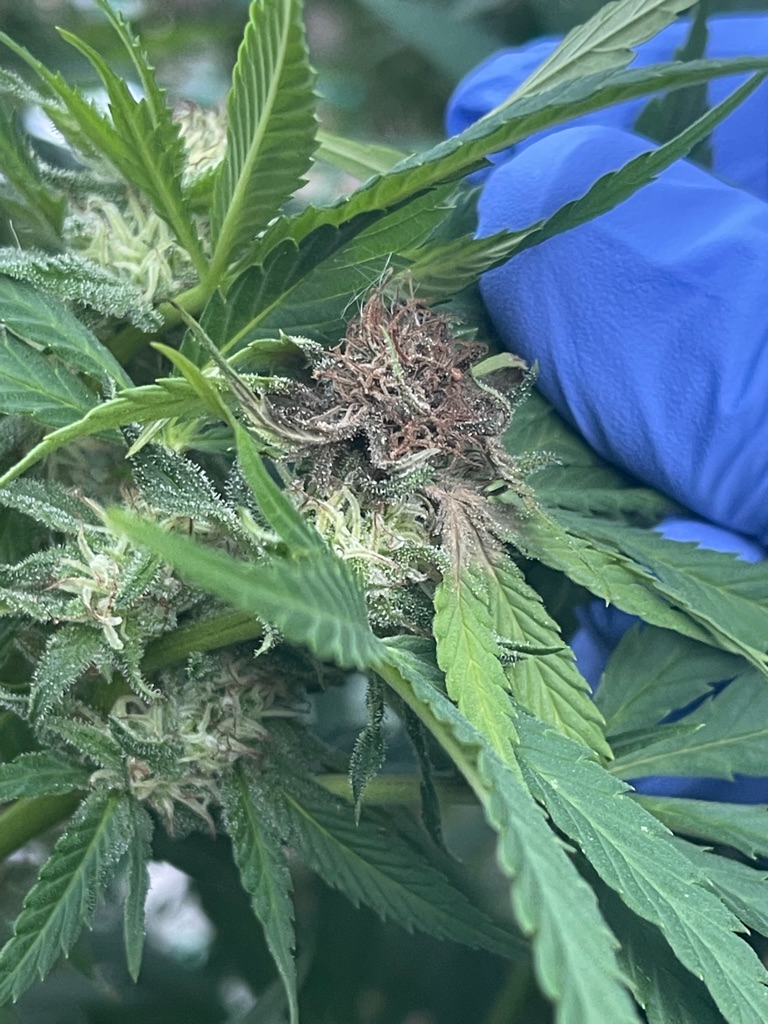
If you grow outdoors on the northwest coast, or if you grow someplace else with high, variable humidity, you likely have experienced botrytis, AKA mold.
While my cannabis is still growing vegetatively, I like to amuse myself into believing that this is the year we’re going to avoid mold. The plants all look so pristine and perfect. But just about the time cannabis starts to flower, the weather begins to change. August is usually not bad. August is the month that plants get large and flowers begin to develop. August is still summer, so there are plenty of warm days, and my plants are still getting a solid ten hours of sun.
Plus, I don’t get nearly as much of the worst mold as I used to get, because of the Stargus foliar spray. Unless something is systemic in the plant, or cosmetic, I rarely lose a bud to mold. If worm mold gets into a flower, that would be the sole exception. But even that has become less common, because of the way Stargus blocks botrytis from attaching to flowers. I wrote more about Stargus in an older blog: Know Your Bats & Spray Your Stargus.
But two days ago, I saw frost on my breath during my morning cardio hike. Humidity is remaining high and a chill is returning, even though afternoons still tend to be warm. It was 44.5 degrees (6.9 C). Fan and sugar leaves will soon begin to show fall colors.
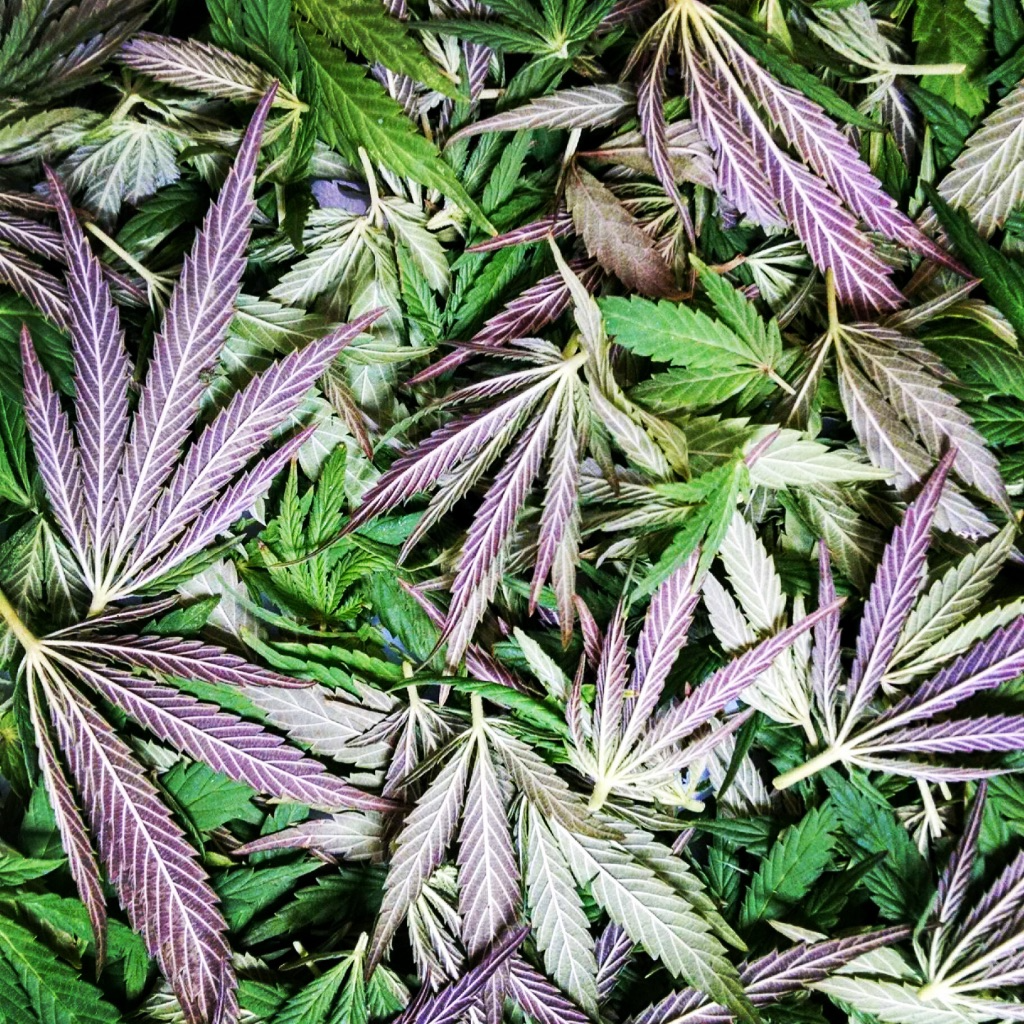
It’s a beautiful time for the grow. Flowers are developing and surrounding leaves are turning. It’s a time where I take the most photographs.
But beneath that veneer lies the working truth–Botrytis is on the rise and it comes from a variety of sources. Worm scat, dead insects trapped by sticky flowers, a bad cut that strips bark, unsanitary instruments being used. The last one is especially germane for me. I can’t tell you the number of times I’ve used scissors to remove mold and then, without thinking, immediately continued pruning with the same scissors.
Oops.
The second year I grew, we humanely and foolishly thought we could grow without using BT. We lost approximately 40% of our total crop to mold caused by moth worm scat. The only way we saved the other 60% was by eventually spraying BT.
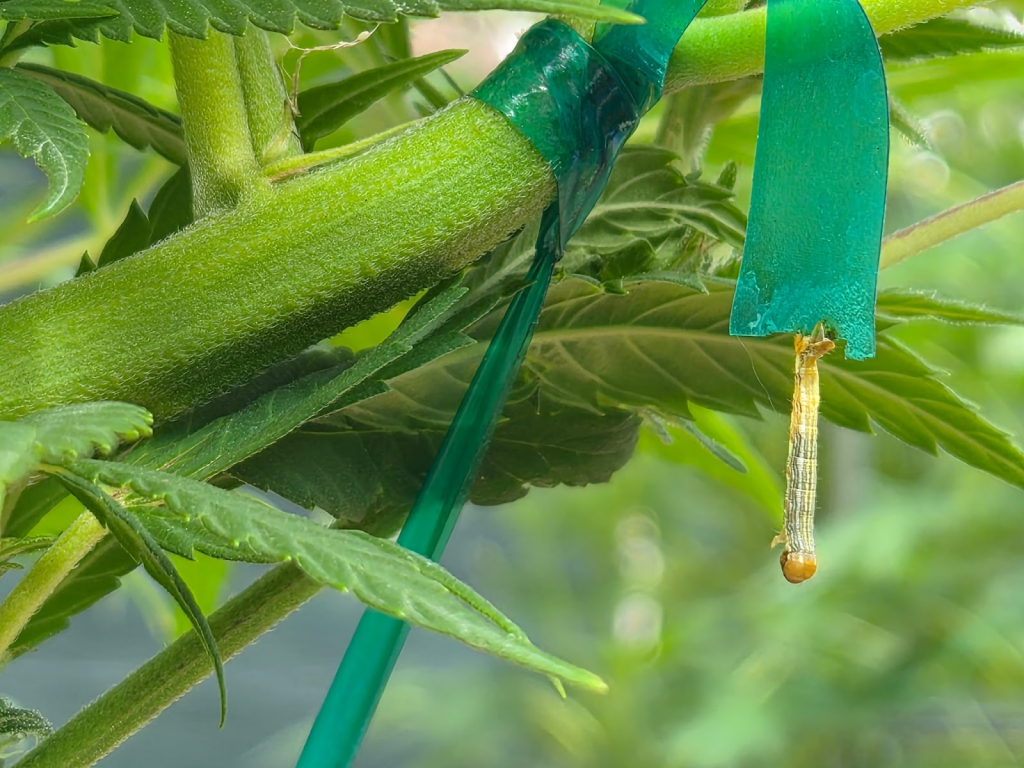
A recently BT’d worm, photo courtesy of Bee.
During that same year, we had one particularly moldy plant, a beautiful Granddaddy Purple clone with some spectacular kolas, and that plant was the center of mold in our garden. It rotted right in front of our eyes. In my opinion, growers in high humidity should not attempt growing this cultivar outdoors.
We decided to use the Granddaddy Purple for educational purposes, to learn how to salvage whatever usable medicine was still on that plant. We cut off mold and treated that rotting mass for a couple of weeks before harvesting what we could. For a small plant with huge kolas, we ended up with 96 grams. The rest was tossed. We were way too disgusted at the time to take a single picture of our experiment.
Bee and I agreed we would never do anything like that again.
And we haven’t, until now.
As I indicated in last week’s blog, growing conditions on the north coast this year have been challenging. There’s been way too much overcast. North of me, where CBG auto flowers were being grown for Mr. T, the grower faced weeks of overcast. High humidity and no sun is a recipe for a difficult grow. The decision was made last week to cut our losses and harvest early, before the plants were lost to mold. No one expected the grow to be socked in all summer with fog. There was very little the grower could do, other than watch closely and remove mold as it appeared. We didn’t expect mold in the middle of summer, but that’s what we got, and conditions never improved from there.
The plants are being pulled this weekend and brought to me to salvage the medicine, not at all unlike what we did with Granddaddy Purple, though I’m told the areas of mold are relatively small-sized. We will cut off all the mold that we see, and then we will wash off all the trace mold remaining. Then we will extract all the usable medicine we can find from these plants.
But before those plants got here, Bee finally came home healthy and we were able to do our first collective plant inspection on our crop in about four weeks. Given the extreme humidity we’ve been facing, I was bracing myself for what fresh eyes could find.
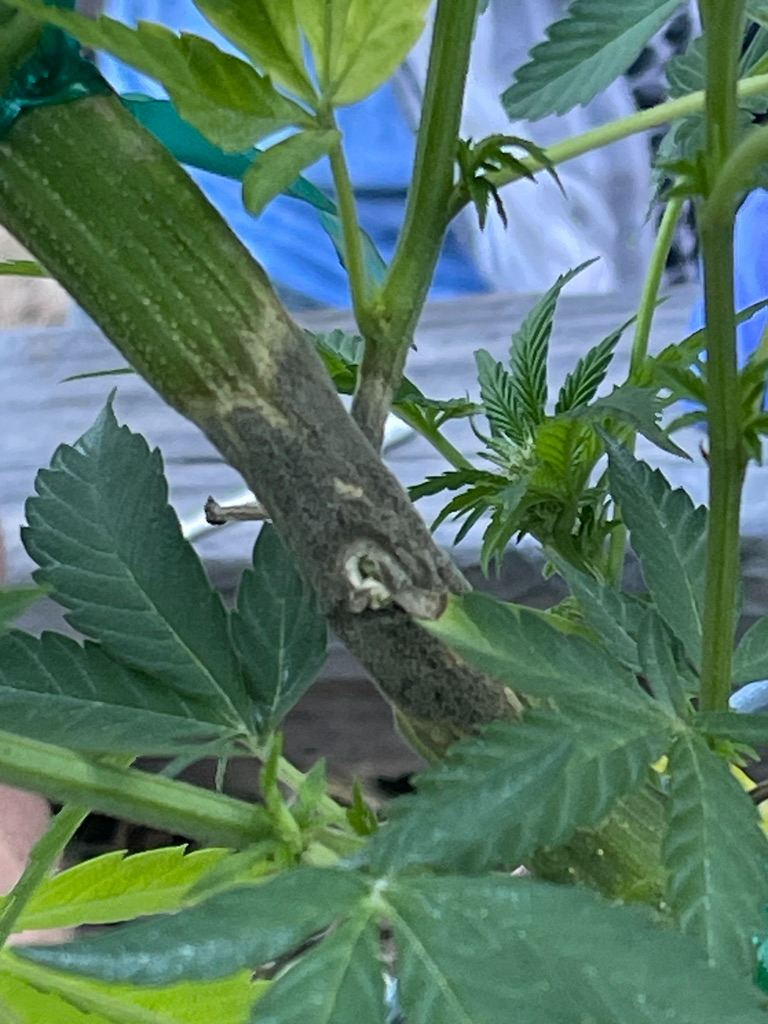
That’s a lower stem with surface mold. Probably started by a bad cut or a fan leaf strip, this is what happens when a cut is not immediately treated with honey under these conditions. So, we had to pour rubbing alcohol on the mold to help kill surface spores. Then, using a sharp knife, we cut off the mold, applied more alcohol and coated the entire area with honey. BTW, the alcohol also helps clearly identify the mold, because the alcohol causes the treated area to become very dark. We’ll do the same thing tomorrow to see if any dark patches “pop” to our eyes. If so, more cutting, followed by alcohol and honey.
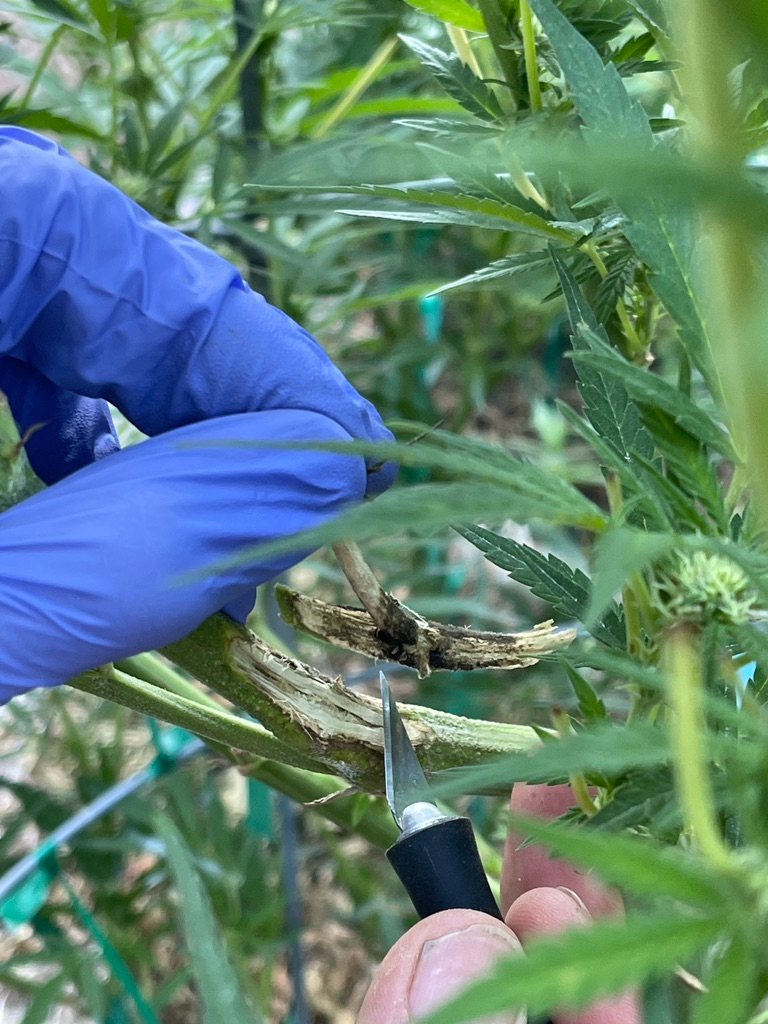
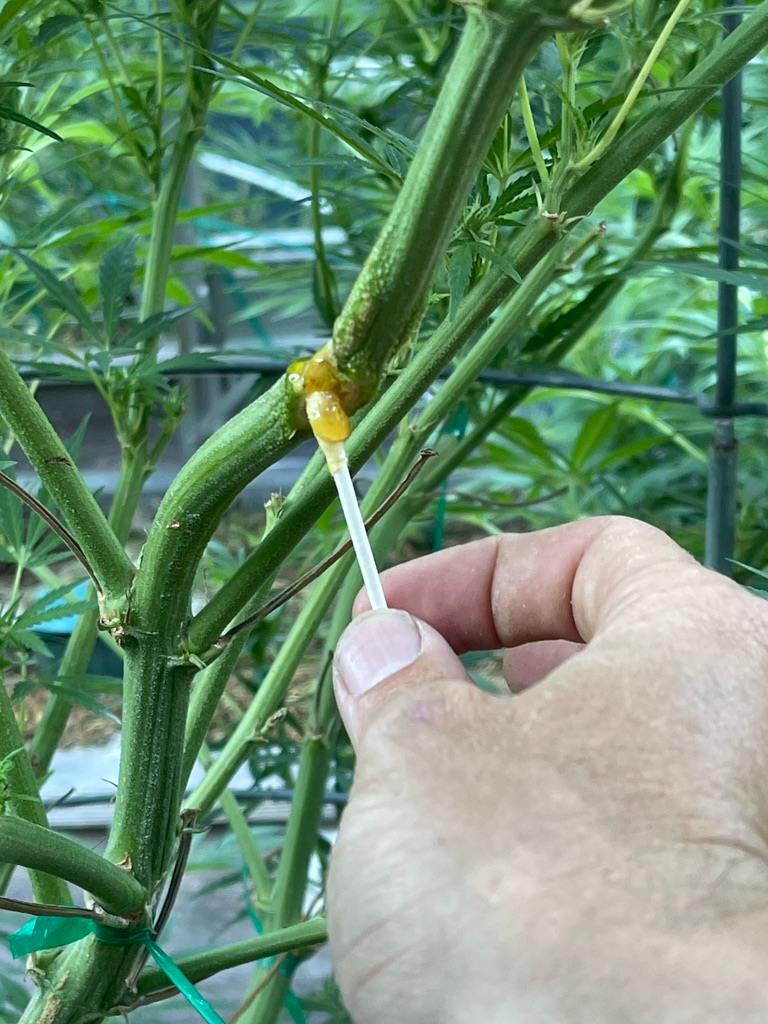
As long as the branch holds, this process can be repeated as many times as needed to remove the remaining mold. We treated four different spots on three plants, primarily, on the two Fruitcakes we have growing. All of them were on lower parts of the plants, where they got the least amount of visual inspection from me. Three of them were clearly just surface mold and were relatively easy to get off. One spot was deeper, on the inside of an inner stem on Roś́e. We’re going to have to watch that spot, because we might not have been able to extract all of the mold, or kill all of the spores. We’ll know in a few days. If that bough begins to droop (limp leaf on an entire branch) then that branch will need to go in order to prevent the mold from spreading to the rest of the plant.
There was also evidence within the rot of some type of beetle or mite damage, tiny tunnels that definitely looked like the result of a boring insect. This is probably how the mold spread. Because we saw evidence of this on two different plants, there is some kind of infestation going on. It’s time for a slightly more aggressive approach to foliar spray: Dr. Bronner’s Castille Soap. The same recipe I use for killing aphids will be used against these boring insects. This week, instead of using Grandevo, on my IPM spraying day – Tuesday – I’ll hit them with soap. This will kill aphids and spider mites, among others.

That dark patch in the center of the wound is where I apply alcohol and honey two times a day. It seems to be working.
Obviously, this is not what we want to do, but we will do it without regret in order to save the useful medicine still on the plant.
These were relatively easy fixes, and considering the extreme humidity that we’re facing, these are minor problems. The spread of the surface mold could also be slowing due to the Stargus foliar spray. But without removing the actual mold, sections of the affected plants were still at risk, and will remain so throughout the remainder of the grow, requiring daily inspection, due to the high humidity. But the best news in this mold event is that none of this surface mold was near a flower. No mold of any kind was seen near a developing bud. The Stargus is doing its job.
On Sunday, the CBG auto flowers arrived. The first thing we needed to do was organize them. I truly appreciate that the grower had a numerical id on each plant. This saves me from doing this task prior to getting started. When we send in the five grams from each plant for testing, we need to be certain which sample goes with what plant. We need to know which plant actually has CBG and its percentage. Further, we need to verify that every plant has CBG and isn’t something else, or are duds in some other way.
This is a quality control issue, and I bring it up not to disparage Oregon CBD, or any other company that packs seeds for delivery, but to point out what those of us who grow from seeds already know–not all seeds are the same. Sometimes, seeds slip in that don’t belong.
In other words, I need to know which specific plants have valid medicine, and which plants are, in fact, something else entirely.
By testing almost everything that I grow, I routinely encounter plants that are not what they were advertised to be. I have documented how often I grow “CBD” plants that have no CBD whatsoever. I have also documented certain cultivars that I have grown, which turned out to not be those cultivars. And I have grown “CBG” plants that turned out to be CBD plants, with no CBG in them.
For quality control folks packing seed orders, it’s a thankless task. All seeds look alike.
All of this underscores why I test plants. It’s the only way to know for sure that you actually have what you think you have. In the case of all these CBG plants, in order to make medicine, we need to know which plants are legitimate. We also need to exclude those plants that are not what we wanted to grow. We don’t want to dilute this FECO with anything other than CBG.
So, every plant gets a number so each test score can be identified. Once we get the tests back, we’ll know right away which plants we can use and which ones we should toss.
Remember, this is medicine for a person with stage four cancer. You don’t screw around and make assumptions about the medicine. To be certain, you get it tested.
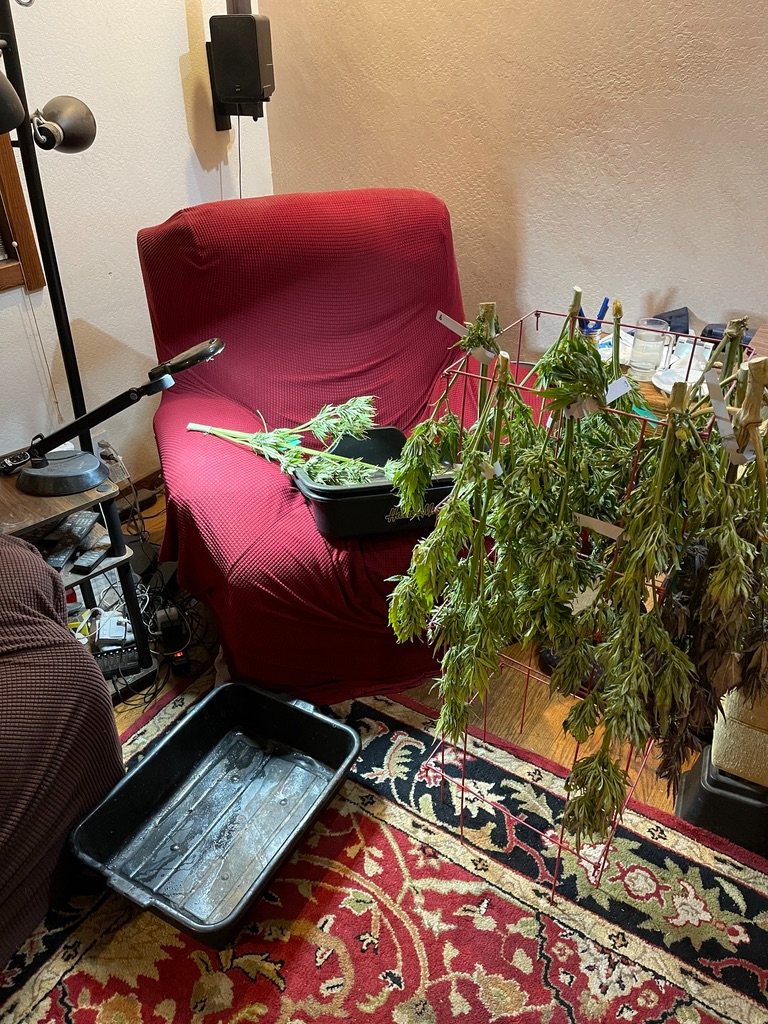
So, I’m back in my chair, utilizing some magnified light to help identify moldy areas that must be removed. It’s a good warm up for the harvest that will begin in a month. I’m not even bothering with leaf removal. Just looking for mold. There’s enough visible already to warrant a second full inspection after the plants have been washed and dried. In the first ten boughs I’ve inspected, I’ve probably cut off over 30 small pieces of mold.
To be perfectly clear, I am salvaging potential CBG medicine from plants that have been battling mold for weeks. For a grower, this is some of the hardest work there is, because to see mold hiding on an otherwise lovely bud hurts the heart. To remove and throw away a bud is not a happy moment, especially when you’re trying to help save someone’s life. Those are the stakes.
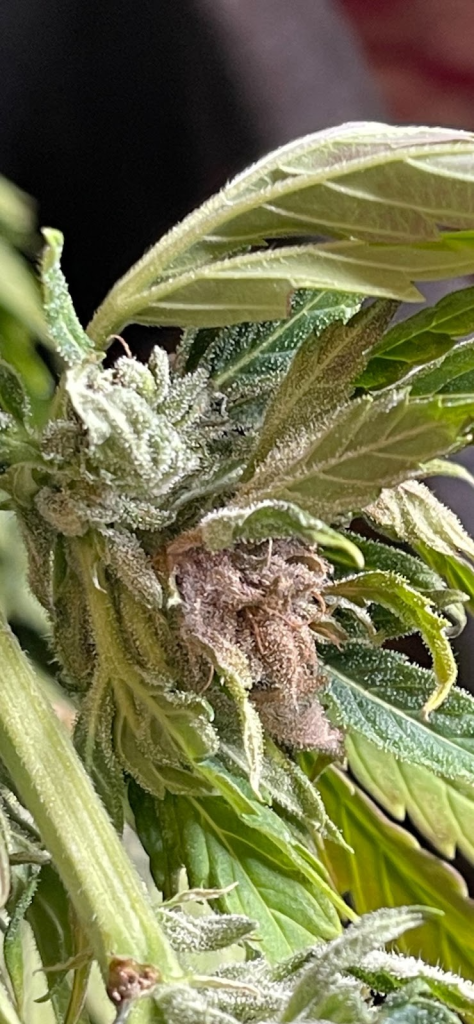
When you see brown like that at the bottom of a flower, that bud has to be tossed. It cannot just be washed off.
Because these flowers were harvested weeks earlier than normal, they are not fully formed. They are not firm buds, either. They are airy and separate easily. In my experience, the airy quality is similar to other hemp plants I’ve grown. Which is handy for this inspection, because with this much mold, I’m having to literally pull apart every flower on every stem. You can’t glance over a flower that you think is clean, you have to pull the flower apart and look inside; especially towards the stem.
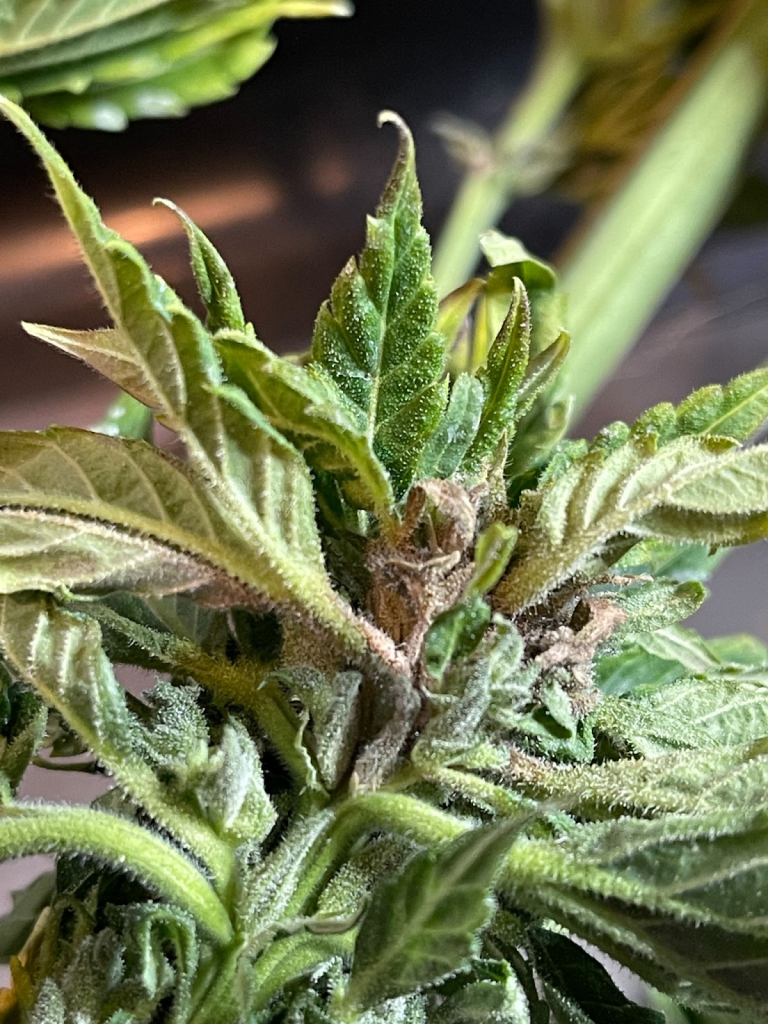
Of course, it’s relatively easy to spot mold on the outside of a flower, because the brown color is unmistakable and impossible to miss, but more than 75% of the mold today has been on the inside of the flower, concealed at first glance, making everything growing outside it untrustworthy. I can see why the grower was so frustrated.
There have not been any nauseating whole flowers gone moldy, though I’m confident some of them were removed before I received the plants. I can see where flowers have already been cut off.
Clearly, this grow would have benefitted by being indoors in a temperature and humidity controlled environment. We didn’t have that choice. These plants have mostly received fog for ten weeks. There was nothing the grower could do. The plants could not safely make it to twelve weeks, which would have been my preference, and my expectation, given these were grown in the middle of summer. Having an earlier harvest has been one of the main goals for my own grow this year.
There were 30 small auto flowers to inspect, wash and dry. Until they are tested, it is impossible to know how much medicine is on the plants. As I trim mold, my goal is to make sure there is enough flower to test and still have enough left to make medicine.
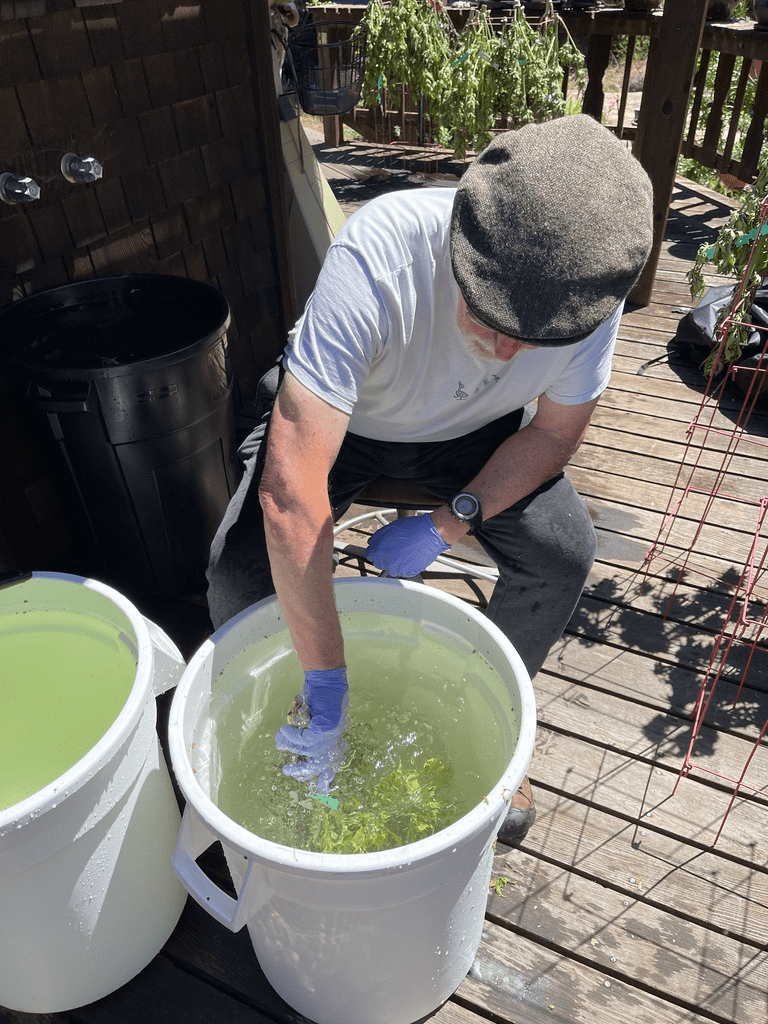
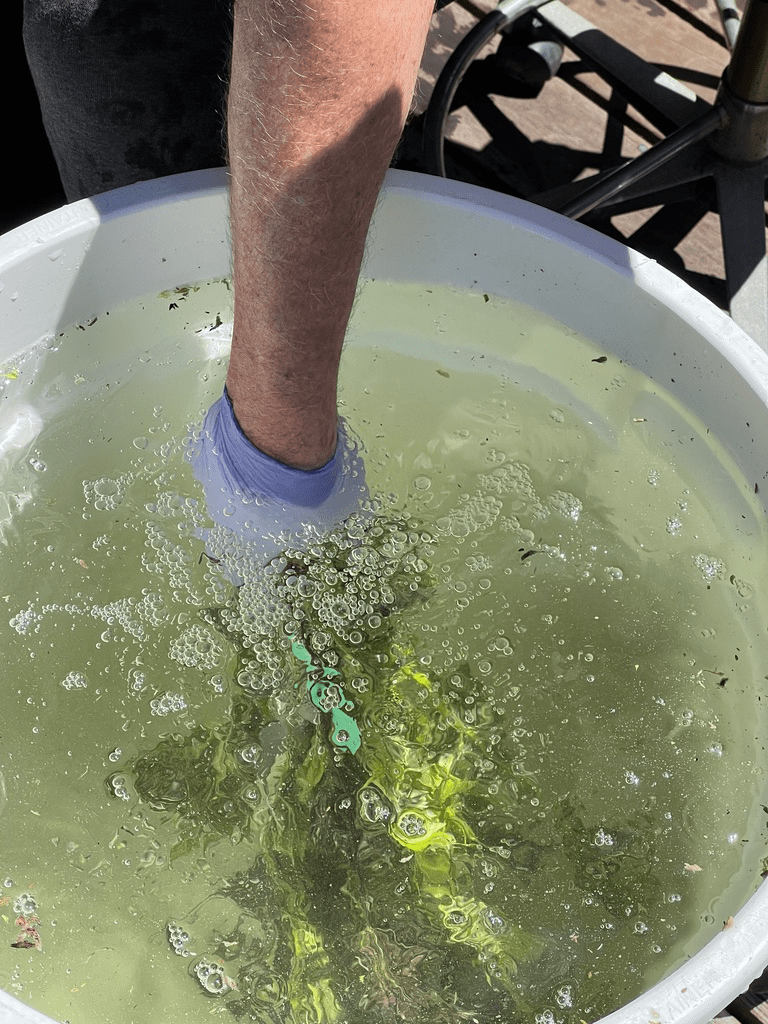
Bucket #1 has water and peroxide, hence the bubbles.
Bucket #2 has water, baking soda and lemon juice. Bucket 3 has hot water. Bucket 4 has cold water. I submerge the flowers and stir for a minute in each bucket.
Then I hang the plants on a rack outside to photosynthesise for the day, before taking them into the temperature and humidity controlled cottage for 12 days of drying.
I have written much more about washing in another blog, Washing Cannabis.
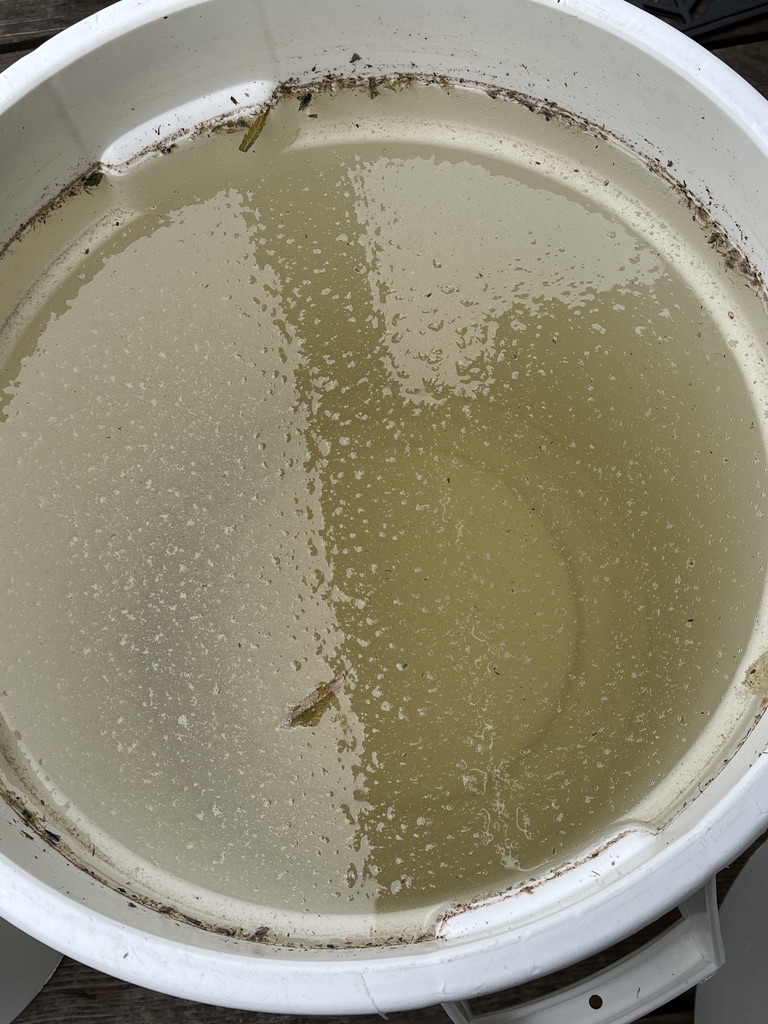
The water was predictably filthy. The above photo is from the peroxide bucket, where you can see the color of the water, the insects and debris. The film on top shows how much powdery mildew was washed off. My inspection showed some mold on all but a few of the flowers. It was not huge amounts, just little bits of mold, but there was enough to make me not at all confident that I got it all on my visual inspection.
My feelings were confirmed when mold appeared in this bucket. Once these plants have dried, they will get another inspection and if any trace amounts of mold still exist, they will be found. I frankly don’t think there will be any more after the washing today. In the past, we’ve never found mold after washing the plants.
Put a fork in me, I am done.
Except, during an evening plant inspection in my beds, two of the surface mold branches, (both smaller, lower branches that probably should have been pruned on both Fruitcake) were drooping and had to go. The boughs were cut above the rotting part, swabbed with alcohol and sealed with honey.
As a general rule with botrytis, once it is discovered, my job is to ensure the safety and survival of the entire plant. I will remove whatever is necessary to save the plant.
A courier date with SC Labs is set for September 11. Most plants dry for ten or eleven days in my cottage, but with an extra inspection thrown in for good measure, I’ll give them an extra day. We are not trimming anything. Everything will be turned into FECO once we have the test results. Once SC Labs has the samples, testing takes about three days.
Through this process we will learn a lot about CBG autoflowers. For example, we should learn how much harvesting this early hurts them. We’ll learn how much medicine we can expect when growing outdoors in the fog. We’ll have a baseline for what to expect when we grow these auto flowers again, hopefully to full term. For everyone involved, this is a long-game project and we will always work to improve. I believe this grower wants another shot at these seeds, but indoors next time. I want to see how they do indoors, too.
Next year, I will grow some CBG auto flowers, but I also want to grow the White CBG, the larger version, the one where you can get over 20% CBG.
Growers, you know how difficult it is to see mold on your flowers. You know how much it hurts the heart.
But today was not about growing, or even dealing with mold.
Today was about doing a solid for a sick person in need. Everyone involved with this is emotionally vested.
The drying cottage is humming with the sounds of multiple fans, an air conditioner and the dehumidifier. 30 CBG auto flowers are drying in a temperature and humidity controlled room. As light creeps toward another dawn, I add to the early morning cacophony with a battery powered foliar spray full of soap. In the bare light of 45 minutes before sunrise, no one can see me sweating. Flowering time is fraught time, and fighting mold is when outdoor growers truly make our bones.
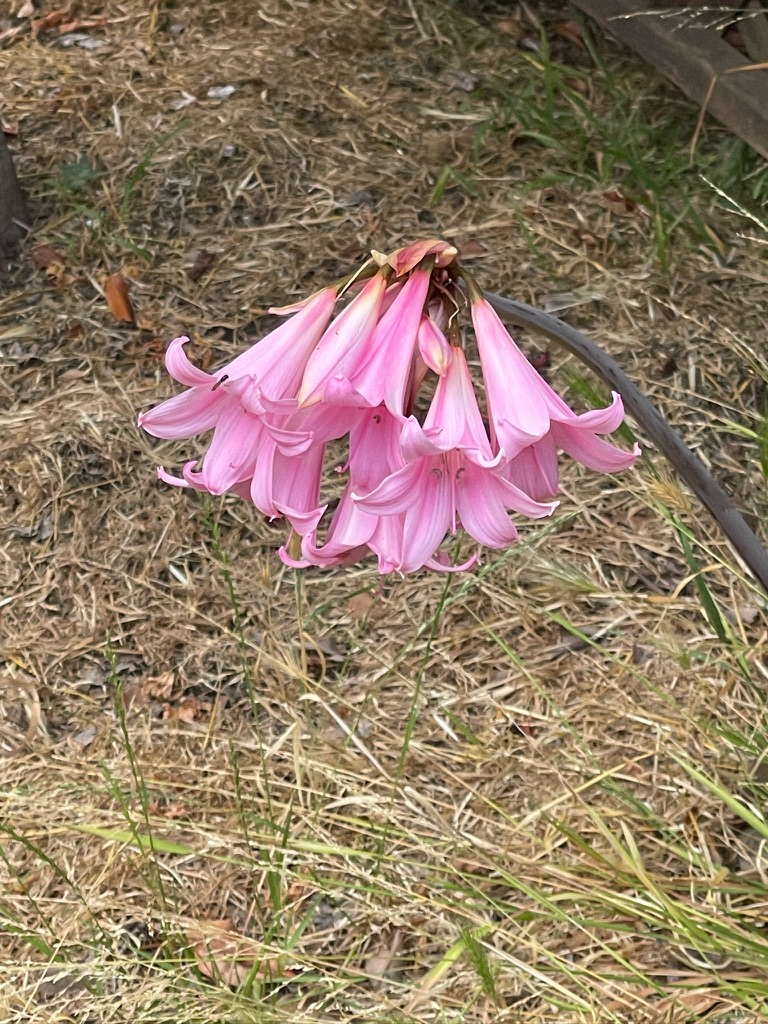
After all that disgusting mold, I couldn’t let you go without seeing a naked lady.
Hey Friends: If you’d like to support jeffreyhickeyblogs.com, please feel free to donate to PayPal @jeffreydhickey.
Or contact me directly with your idea (good seeds are always welcome–and if I grow them, I will get the flowers tested and share with you the results.
Disclaimer: The majority of the links in jeffreyhickeyblogs.com posts are affiliate program links. This means that (most of the time) when you purchase a product linked from my site, I receive a commission.
 Jeffrey Hickey Writes Blogs
Leave a comment