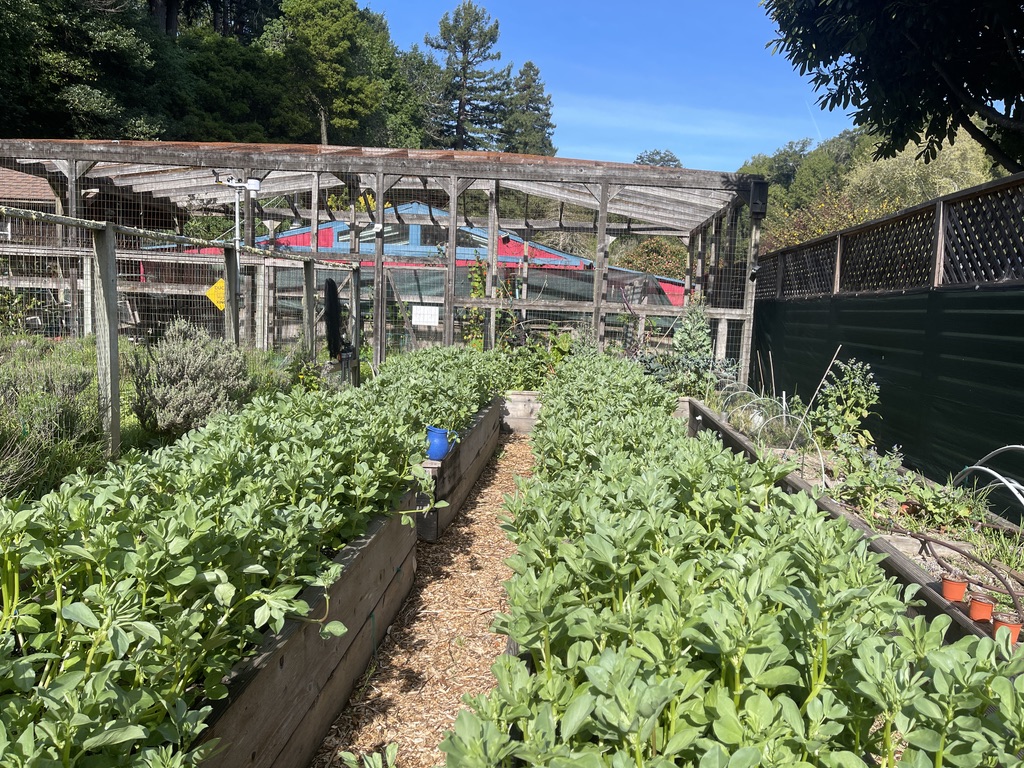
The fava plants, the morning I cut them down.
I start seeds on April 1. This year’s crop is the most significant since I began growing. This year is the first year that I’m going to dry grow my entire crop. At some point early in the vegetative cycle, I will determine that tap roots have entered the mycelium network beneath my beds and I will not water them for the remainder of the grow. They will get one quart of compost tea every week, but no more pure watering. Of course, there’s water in the compost tea, but not very much. It’s mostly nutrients. Any other moisture my plants receive will come from foliar spray runoff, and nature. We typically get some drippy fog.
But last year’s test with Cherry Punch 15 tells me that I’ve been correct about this for a number of years. I started suspecting this about four years ago and have been steadily working toward an entirely dry grow.
This is also the year that I restock the CBG portion of our home dispensary. As those of you who read my blog know, I used up our CBG last year to help a friend. It is critical that I not only replace what I had, but I build up some extra in reserve. As Karen and I get older, the odds for one of us needing something like this go up with each year. CBG will probably be grown every year from now on. As I suspected, CBG is proving to be a very helpful cannabinoid.
I’m planning on growing at least three White CBG this year, along with two CBD plants (Love Lucy, and Sour Electra), and that’s five plants right there. I also need to grow for the sleep portion of our dispensary, so I’ll be growing Banana Papaya for the first time. I was introduced to this strain last year via some butter and oh my goodness, this is a serious sleepy time plant. I’ll also grow Rośe again, both for its sleep potential, but also because both my children and I really enjoyed this strain. It’s not purely for sleep, there’s more to it than that. But if you combine it with some other obvious sleep strain (like I did with last year’s Apple Crumble), you get delightful sleep. Plus, last year’s Rośe was perhaps the most photographed plant. I’d like to grow her again, because everything about this cultivar is cool. One last note on Rośe, if you look at my test scores from last year, she has the lowest THC of the non-CBD plants, at over 18%. But we harvested her a couple of weeks early, because of the flea beetle outbreak. We’re hoping to grow Rośe to full term this year and see what difference that makes in the test scores. She is one of the most interesting cultivars that we’ve grown. Her top three terpenes are Myrcene, Beta Carophylene, and A Pinene. I have not seen that threesome atop the terpene chart before. It’s almost a contradiction. The lead terpene is Myrcene, which is a sleep aid, but to have Beta Carophylene and A Pinene as the next two makes this plant unique. This is a plant that gives energy with the initial burst, and then settles into a more relaxing back end. It can energize me through a movie and then crash me immediately after. It’s not a couch lock, either.
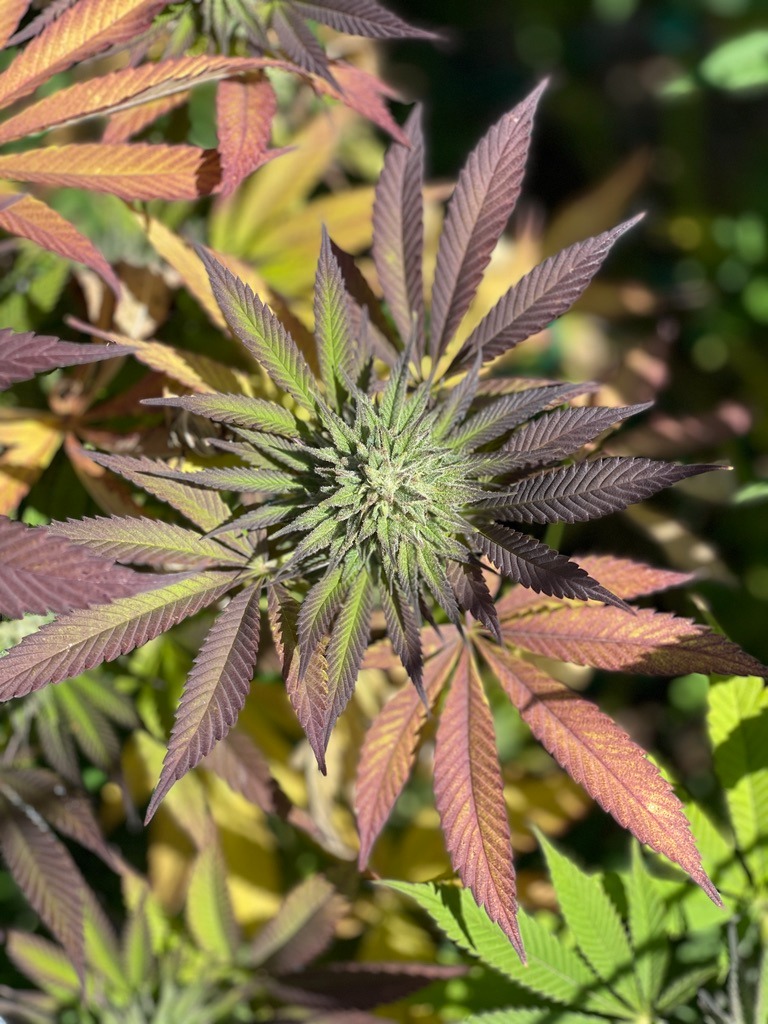
Rośe
I will grow Cherry Punch again. This year, I won’t plant her too early and will be proactive in preventing aphids from attacking her, or any of my plants. Cherry Punch is a delight to grow. If you are an inexperienced grower, this one will grow large regardless. Lots of air and space between giant buds. Didn’t have to prune much of either Cherry Punch that we grew last year. Highly recommended strain and a true 50/50.
Will grow Queens Special One this year. I tried last year, but aphids destroyed her and it was entirely my fault. So, I owe this cultivar a much better grow. She’s going to get bed 18, which has a history of producing bigger plants. This cultivar is known for growing large. We’ll see. She is another highly recommended 50/50 with a historically favorable terpene profile. That generally means low levels of anxiety from the flowers.
After that, there will be a couple of cultivars to be determined by seeds. I’ll dig through my inventory soon and look for surprises. Also might not grow anything different, but might grow more than one of certain cultivars, like possibly Banana Papaya.
I will probably grow 10 plants this year, because I want to use two of the cannabis beds for tomatoes. I want to grow some productive tomato plants.
The only experiment this year is the big one, the dry grow. I’m all in.
Another interesting factor this year–the majority of seeds are feminized. The CBG is feminised, the hemp CBD (Sour Electra) is feminized. Cherry Punch, Queens Special One and Banana Papaya are feminized. The only plants I’m growing this year from regular seeds are Rośe and Love, Lucy. That’s going to make everything so much easier in the cottage. I’ll be sexing 18 regular seeds and I’m hoping to get a couple of females. If there is a third, I might drop it in a smart pot and just let it grow. But sexing 18 plants is less stressful than 70-100 starts.
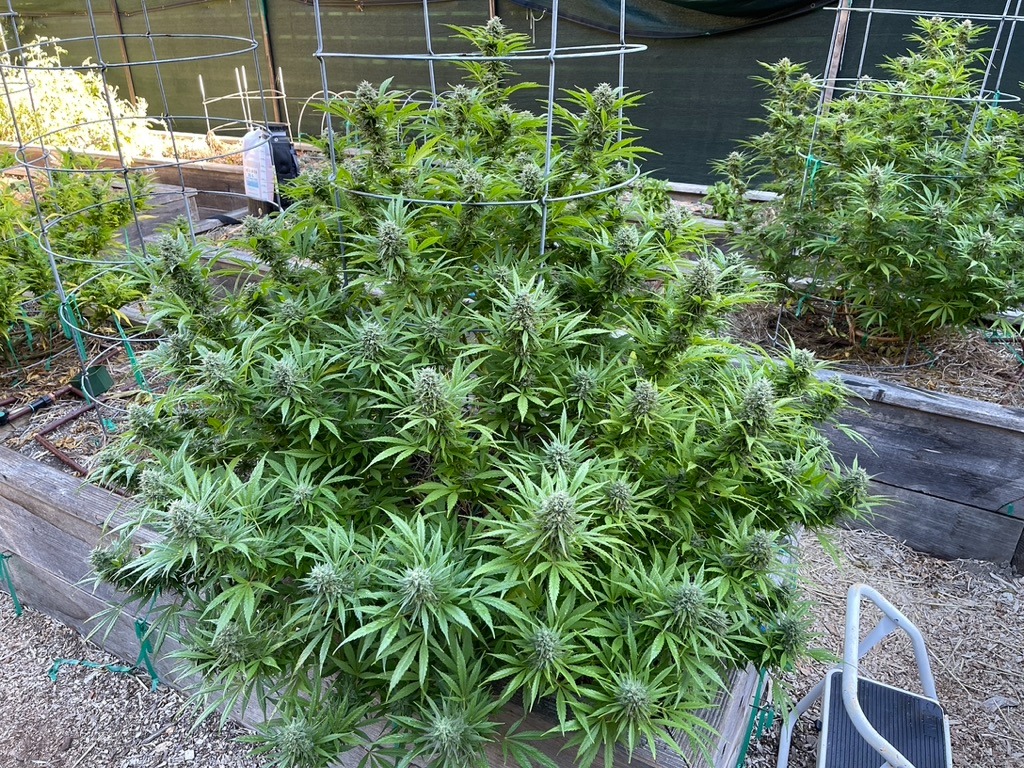
Love, Lucy
A special note here regarding Love Lucy. There are better known CBD strains, but I’m not sure there is one more truly medical than Love Lucy. We are finding so many uses for this strain, including as a sleep aid, because it’s high in myrcene. Over the last year, we have found that Love Lucy helps with many of our maladies. It also was a huge aid when we had Covid last August. Wanted to call attention to this cultivar, in case anyone out there is looking for an effective CBD plant. You can find seeds for her at Humboldt Seeds.
No fish was used this year to fertilize. There should be plenty leftover in the soil to help with the grow this year, and I’ll be augmenting with dried guano. The worms will soon go to work scatting nitrogen into the soil. There will be no nitrogen issues.
I won’t be putting any plants into beds until May. Consequently, the supplemental outdoor lighting will not start until May as well. Those lights will shine from 5-9 every morning until July 22. By stopping the lights on that day, it will trigger the plants into the flowering process. Hopefully, like last year, all of the plants will be harvested before October 15. That timing helps minimize late season pathogens.
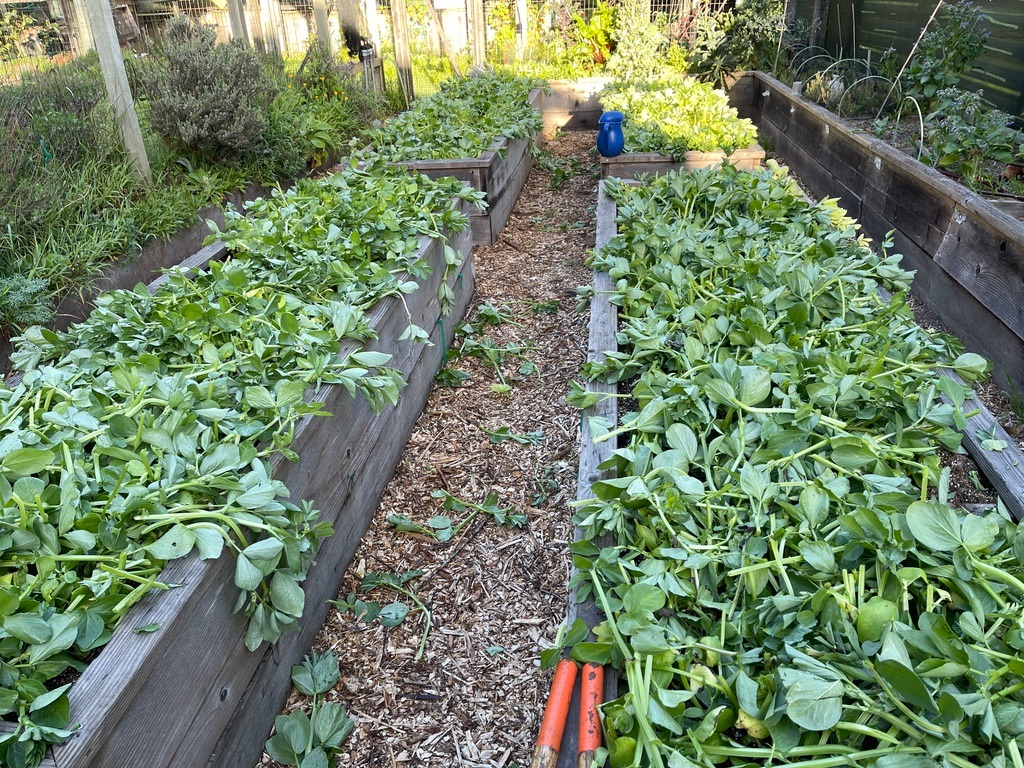
Favas were cut down on March 23, just past spring solstice. The beds were watered completely and a foliar spray of Dr. Bronners applied before covering the cut favas with straw. Now I walk away and let the worms consume the downed favas for the next six weeks. After the worms scat nitrogen into the soil for six weeks, planting will begin.
As always when growing favas, I include the following critical pro tip: Leave the fava root balls in the ground. Put your plants in beds around them. Those root balls will serve as slow leaking sources of nitrogen for the entire grow.
Something I’ve noticed the last two weeks, something that I did not see the entirety of last year–days with around 50% humidity. It was high humidity all last summer. Our favas grew explosively during this period and I’m holding out some hope that this sort of humidity dominates my entire grow. It has been perfect conditions; albeit two months early. I would not mind an entire grow with less humidity than last year.
I’ve spent some time recently communicating with seed merchants. I’m trying a new source this year. I wanted to be more certain of each cultivar that I’m growing and this might be the first year in many where I don’t have any surprises. I expect to grow exactly what I’m hoping to grow. The only regular seeds are from trusted sources, Northcoast Novelties for Rośe and Humboldt Seeds for Love Lucy. I’ve never gotten incorrect seeds from either shop.
All CBG and CBD seeds are from Oregon CBD, a trusted source.
Queen’s Special One is from Royal Seeds, another trusted source from the past.
The new strain this year will be Banana Papaya, which I sourced from the Multiverse Seed Bank. It is my first time buying seeds from them, and they seem entirely enthusiastic for what they sent. As I told them, I’ll let them know exactly what I think once I have the test results back and I can confirm that what I’ve grown is what I ordered. I am very excited to explore this cultivar. It looks like it could be a sleep plant, or something with some energy, it reminds me in this way of Shiatsu Kush, a long time favorite from Japan. We’ll see what kind of phenotypes she grows.
So I’m pumped for this grow. I cannot wait to dry farm the entire crop. This might be the future of growing cannabis for me. I already suspect that it is.
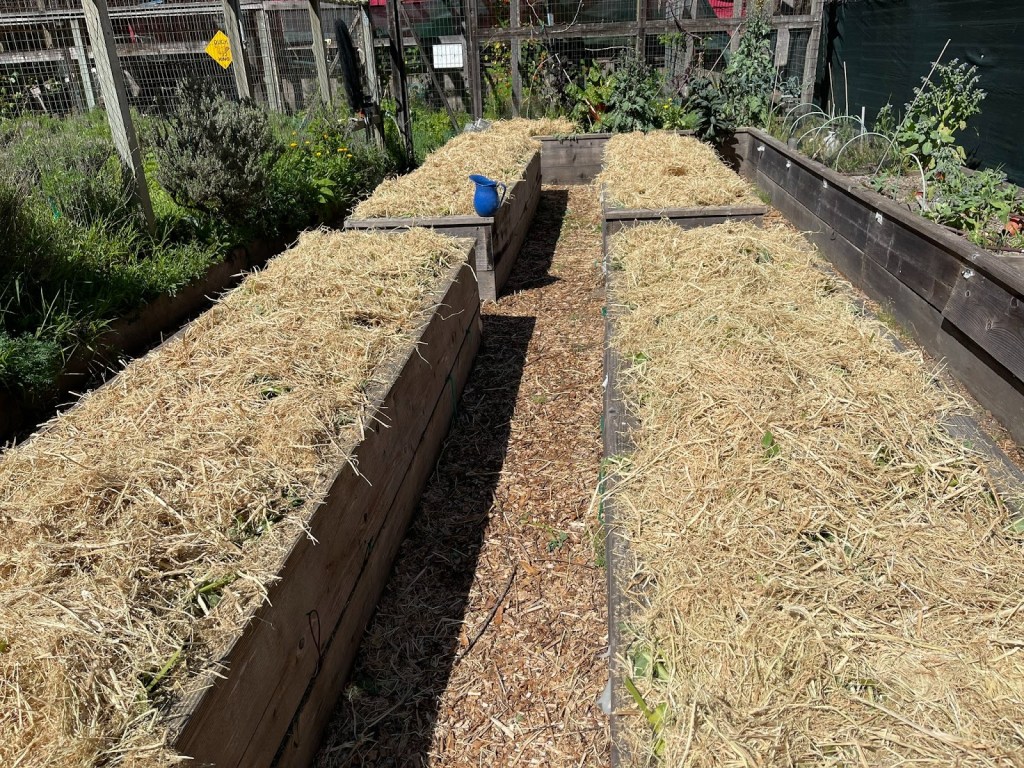
Favas cut down, straw spread, time for the worms to get to work. Everything tucked in and cozy. Plants go in the ground in 5-6 weeks.
Before I go, a quick reminder that tomorrow, March 28, is a No Kings Day. If you are not happy with the way things are going in our country, I strongly encourage you to join a protest and let your voice be free. We need our so-called leaders to know how many of us there are, and exactly how pissed off we’ve become.
Survive and Vote.
Hey Friends: If you’d like to support jeffreyhickeyblogs.com, please feel free to donate to PayPal @jeffreydhickey.
Or contact me directly with your idea (good seeds are always welcome–and if I grow them, I will get the flowers tested and share with you the results.
Disclaimer: The majority of the links in jeffreyhickeyblogs.com posts are affiliate program links. This means that (most of the time) when you purchase a product linked from my site, I receive a commission, which helps support the blog.
 Jeffrey Hickey Writes Blogs
Leave a comment