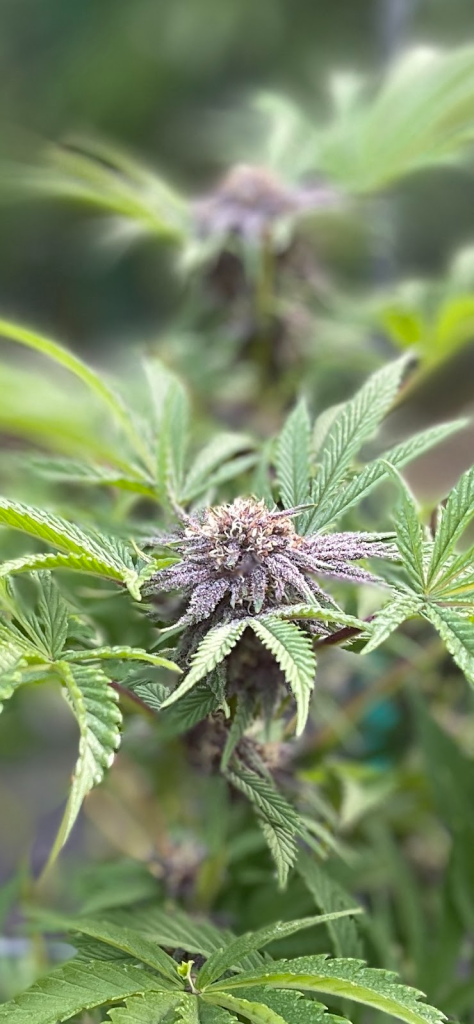
We’re in a harvest month. By the end of this month, more than one plant will be brought down. There are a few plants capturing most of my attention.
The trichome show has well and truly begun. Some cultivars have less than four weeks remaining to harvest while others are closer to six, but they are already bright with frost spreading over sugar leaves.
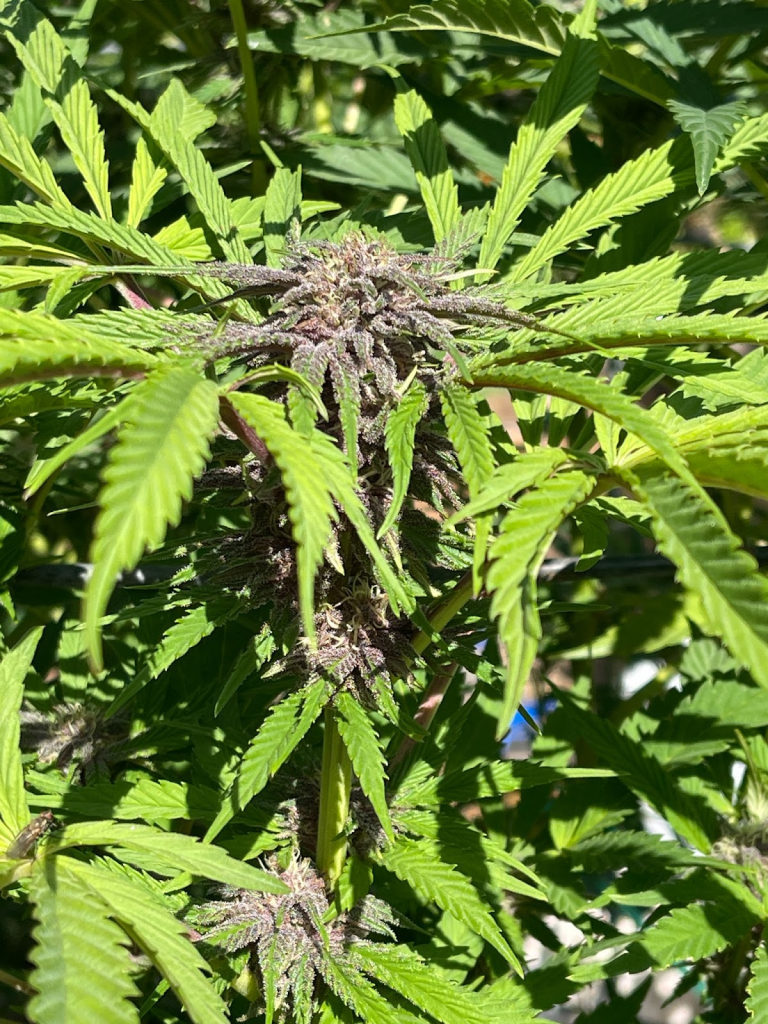
Because I rarely grow flowers that are truly purple, I am hard pressed to stop staring at both Fruitcakes. They seem to be similar phenotypes, though the very small plant I grew last year produced darker purple than these. It’s impressive to me that different phenotypes can produce varying hues of purple. This plant is a wonder to watch, and I highly recommend trying it. It has a euphoric front end if you don’t ingest too much right away. Just a couple of hits to soar, and that’s your pro tip for today.

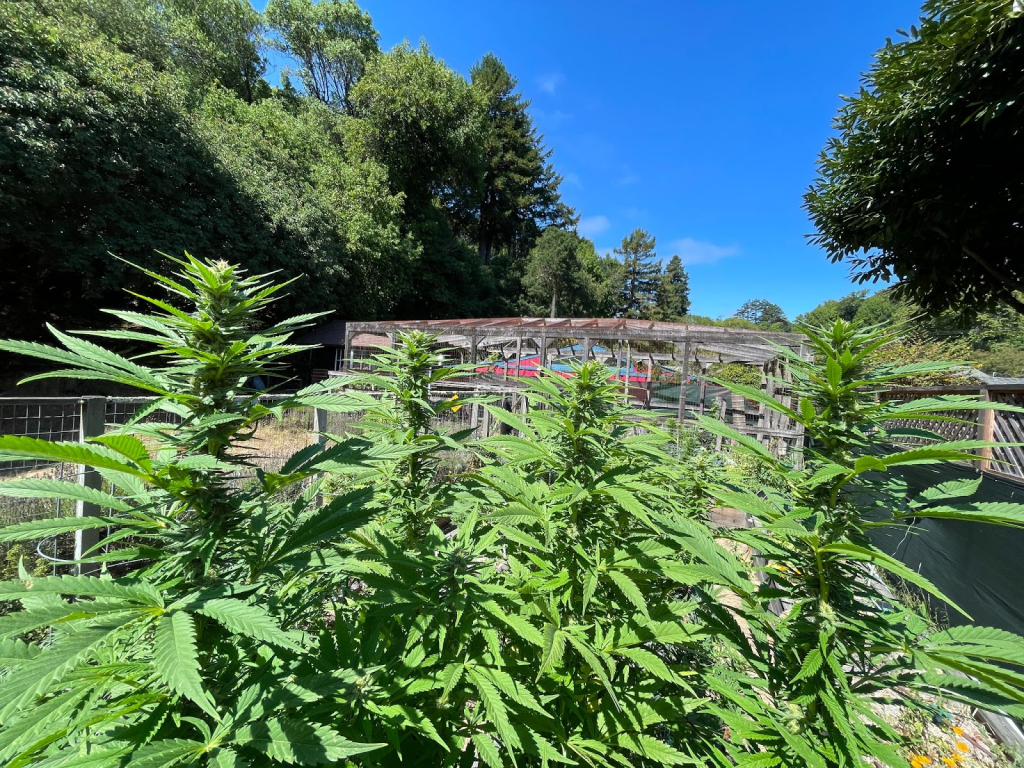
Purple Punch also has four weeks to go, so her flowers are only beginning to get plump. I’m going to speculate a bit on this cultivar, cast some doubt, or perhaps, just wonder out loud – I see no purple in this punch. Perhaps, like so many cultivars with purple in the name, it is only the rarest of their phenotypes that actually produce the hoped-for color. We’ve seen that in other purple cultivars, like Granddaddy Purple and Ultimate Purple, where only one out of five grown showed a light purple hue, almost purple dust. The rest of those looked like standard issue cannabis. Like in the photo. But the cynic in me is going to wait until: 1) I’ve tried the plant, and 2) I get the test results.
Our Cherry Punches are definitely growing as advertised, but I don’t have the same confidence that our Purple Punch is really Purple Punch, despite having grown beautifully, with potent looking flowers. So we’ll just have to see. Even if she’s not, she’s probably got some unique combination of medicine inside of her that I can use. My dispensary is littered with surprises that I know how to utilize, because I’ve tested them.
I’ll give you an example: Last year’s ACDC 16, which is not a CBD plant, turned out to be a beautiful sativa hybrid. She has 23.45% THC, 0.097% CBD and 3.4556% Terpenes.
She was a bomb of a plant, and her #1 terpene is Limonene, at just under one percent. That’s a huge amount of Limonene, relative to what I’ve seen in other plants. I wasn’t expecting a powerful sativa hybrid, but I’ve enjoyed her, and she turned out to be the perfect plant to share with people going through chemotherapy. The limonene stops the nausea.
In this case, a surprise plant turned out to be a great medical plant. I wish I knew what cultivar she is. Deeply grateful for the medicine, however.
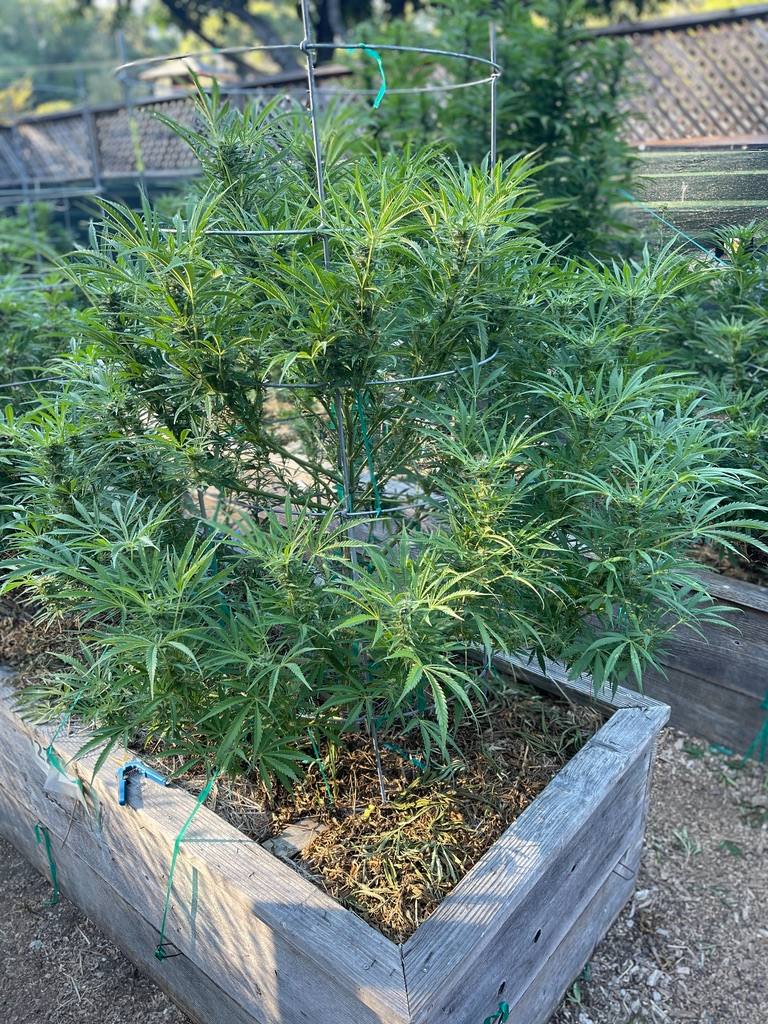
This Purple Punch is tall, trained to spread out wide, and after tons of pruning, she still produces a lot of leaves with long, skinny fingers.
I haven’t grown this cultivar before, so I have no basis for knowing what she should look like, but I always wonder about sleepy plants that grow tall. I’ve rarely grown plants like this. They are usually stout and compact, like both of the Fruitcakes this year. This Purple Punch is almost to the top of the doubled Texas Tomato cage. I have pruned her more than any plant in the beds, so perhaps my work has prevented her from being crowded. Also, while her fan leaves were large and fat, subsequent leaves are of a thinner variety, which is more typical of sativas. An observational aside: Thin leaves are advantageous for preventing moths from laying their eggs.
I’ll have a much better idea after drying and I’ve had a chance to try her, but truly, the tests will tell the tale. If she’s high in myrcene, she’s probably a Purple Punch, otherwise, she could be another surprise. We’ll see, and I hope that I’m wrong. This is a game that I wish I didn’t have to play. But if you grow from a variety of seeds these days, you cannot trust that everything you’re getting is what you ordered.

A quick acknowledgement for Apple Crumble in the unfenced 25-gallon sack. Not a single leaf has been nibbled by deer. Their scat is about 15 feet from the plant, but no closer. The lavender is completely protecting the cannabis. This is a much larger plant than I grew by the lavender last year. I think it’s safe to say that you can grow cannabis if you’ve got lavender in close proximity to protect the plants. We have lots of deer, including multiple babies born on the property. They have not touched this completely unguarded plant.

S. Thai 19 was always going to be a very small plant.
I must acknowledge my sadness at growing Apple Crumble in a smart pot. I wish she was in bed 19, and the tiny S. Thai plant was in the small pot. The S. Thai 19 was never going to grow large. She was simply a leftover plant we had from that cultivar. She had been on my “pretenders” table, not the “contenders” table. I could tell early on that she wasn’t going to be a vigorous grower. My sadness for Apple Crumble is that she obviously wanted to grow large, and because she could not break through the bottom of the sack, she couldn’t. I also could have cut the bottom of the sack out, so she could have gone directly into native soil, but decided to simply let her grow as much as she could in the cloth pot, because I hadn’t done that before.
As a result, in the future, I think I’ll only use cloth sacks, or smart pots, for auto flowers. I am not a fan of growing full season cultivars in an enclosed sack. The roots on this plant want to go much deeper. That would have allowed her to attach to the mycelium network, just like 11 out of 12 plants in the beds. The only plant whose roots never went deep enough to join the mycelium was S. Thai 19.
But I can temper my disappointment with this plant:

S. Thai 12
I have not written much about S. Thai 12 until now. I was letting her go, holding my breath, waiting to see how large we could grow this small cultivar. This was the one S. Thai that survived as a female from the “contenders” table. I knew she had a chance to be the largest S. Thai that she could be. These are small plants with small leaves and small flowers.
Last year, we didn’t even get one of these into a bed until June 19, so she didn’t get a full growing season, and she still produced the single highest terpene percentage that I’ve ever grown – 3.9875%. That was from a very small plant. We had so few flowers, we debated whether we should send in any for testing. I felt we must, it was the only way to know if we’d grow her again.
So this year, we coaxed S. Thai 19 to grow like last year’s plant, and this S. Thai 12 to actually grow over the top of the Texas tomato cages. I never expected this cultivar to reach the top. I am thrilled at the number of small flowers she is producing, and I cannot wait to see what impact a full season of growing will have on her test scores.

The Black Krim Heirloom tomatoes are ripening. It’s sandwich time while I inspect plants.
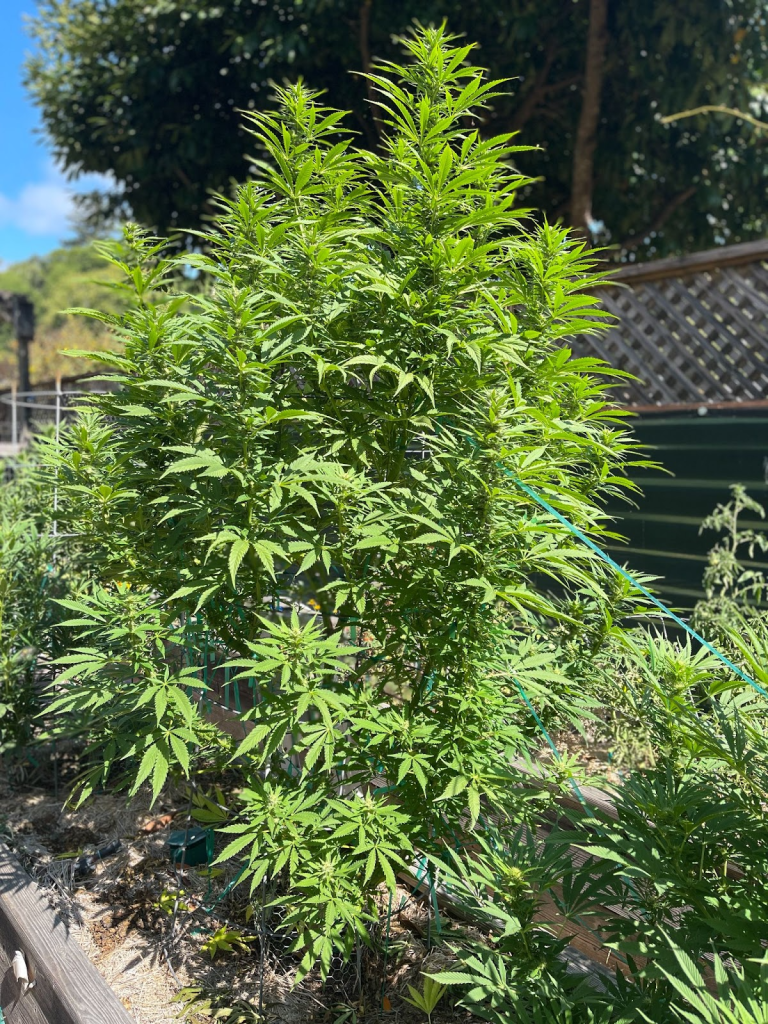
Cherry Punch 15 is maturing gracefully.
When I’m not staring at the purple, I’m admiring this lady who has not been watered since May 25. By the time she is harvested, it will be four months since she was watered.
It feels like I’m watching something new. This is something I haven’t tried before and no one I know has tried either, though I am certain it has happened in nature, if not in someone’s grow. After all, dry farming is an ancient form, much revered by its practitioners.
The thing that is new for me is watching a plant age exactly as the earth itself intends for her to do. I give her a quart a week of compost tea that she would not get in the wild, but the water in a quart of nutrients each week is not what sustains a plant this size. As previously written about in my blog, A Mycelium Network, she is being controlled by fungi, which allocates water to her as needed, and also withholds it when it’s no longer needed, as is the case now. She is beginning to yellow on leaves deep inside. The process is beginning. She also has close to 35 more days left standing, and unless the weather does something awful, I don’t expect she’ll come down early. Just a few yellow leaves have come down, like any other flowering plant.

For this, my first attempt at dry farming a cannabis plant, I want to push it to a true harvest date if at all possible, for the sake of the experiment and the medicine. This plant will be my baseline for information, because I’m going forward with dry farming everything next year.
Cherry Punch 15 was 50 days old when I stopped watering her. She had normal water up to that point. (Normal water for me is less than most people use, only about a gallon and a half per week) Bee and I discussed this at the time and agreed to let her grow without water and see what happened. We were both pretty confident that her tap root had reached the mycelium and that she wouldn’t need more water.
I had to climb a ladder to take this shot. No problems so far on her tops.
On a very personal level, watching this plant grow is probably the most fun I’ve ever had as a cannabis farmer. I’ve grown plants larger than this one, but this one feels different, like I’m breaking a paradigm.

Cherry Punch 15, 35 days from harvest.
I understand that the circumstances are unique and should be studied. I also understand that not everyone can do what I’m currently doing. I am humbled by the opportunity to try this. This is not about my skill as a grower, it’s about learning how to best take advantage of my fortunate circumstances.
I have sat in rooms, both real and cyber, and listened to professional growers talk about water. Every time I brought up how little I was using (and this was well before the extent to which I’m doing it now), I was listened to, and quickly dismissed. The other growers simply could not relate to what I was saying. I was told by one that dry farming would take many years to master, which I did not dispute.
Well . . . I’m having a moment with this now. I’m post Covid, I’ve got some bliss going, and watching that tall lady represent herself seems like a very nice way to spend my autumn. Keeping those tops free of problems will be a challenge over the last month. I have to climb a ladder to inspect them and foliar spray them. Foliar spraying is risky with a long hose that can easily damage a nearby flower or branch while spraying. Spot inspections are not as easy as the other plants. We expect to lose pieces of these tops, and it will hurt when it happens.
But it’s September 2 and that’s 100 days since she got her last gallon of water. She has the possibility of flowers extending down her stems for as much as two feet. Watching her develop is an unexpected form of cannabis enhancement.

First light hits the tops.
Hey Friends: If you’d like to support jeffreyhickeyblogs.com, please feel free to donate to PayPal @jeffreydhickey.
Or contact me directly with your idea (good seeds are always welcome–and if I grow them, I will get the flowers tested and share with you the results.
Disclaimer: The majority of the links in jeffreyhickeyblogs.com posts are affiliate program links. This means that (most of the time) when you purchase a product linked from my site, I receive a commission.


 Jeffrey Hickey Writes Blogs
Leave a reply to Jeff Hickey Cancel reply