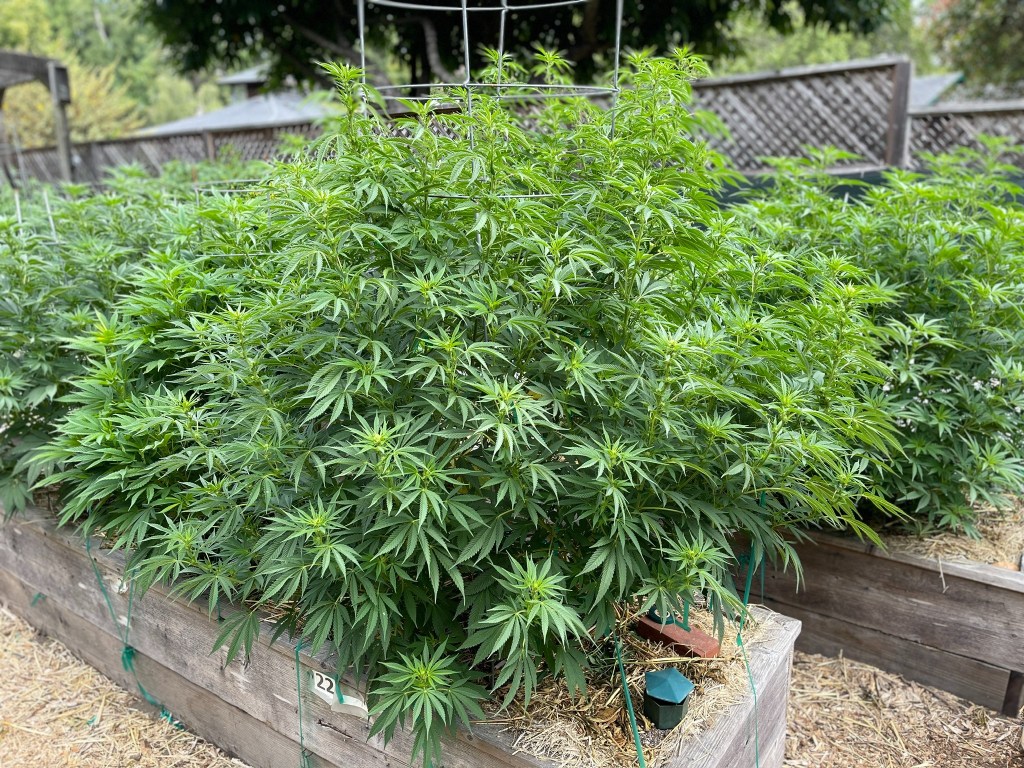
Banana Papaya 22 has bushed out.
First, the dry grow is going exactly as hoped. Cannabis and hemp have not received pure water since May 25. They’ve gotten a quart of compost tea a week, but that’s the only moisture they’ve received, other than runoff from foliar sprays. They are all looking great and very healthy. It looks like it’s going to be a decent-sized yield.
However, this year’s grow has changed in a major way, and I’m grateful to have the tools to roll with it and pull it off. This change will probably impact my future grows.
If you’ve read a majority of my blogs, you know that I’m a weather nerd. I study long range forecasts, and make my decisions accordingly.
This year, we are awaiting the development of an El Niń́o event. It is predicted to have an 81% chance of being a massive event. In Northern California this can mean a lot of rain or very little at all. Historically speaking, however, this likely means a significant increase in rain. Being that I’m already in a rain zone, the potential for flooding and damage to the area is real.
This is not a warning that I can ignore or just blindly pretend that nothing bad will happen this time.
We average 40 inches of rain per year, but two of the three El Nińo years since 1982 have seen 60 and 70-plus. Given the prediction that this will be either a strong, or very strong El Nińo, 100 inches of rain is not out of the realm of possibility. Even at 60 inches, flooding is likely.
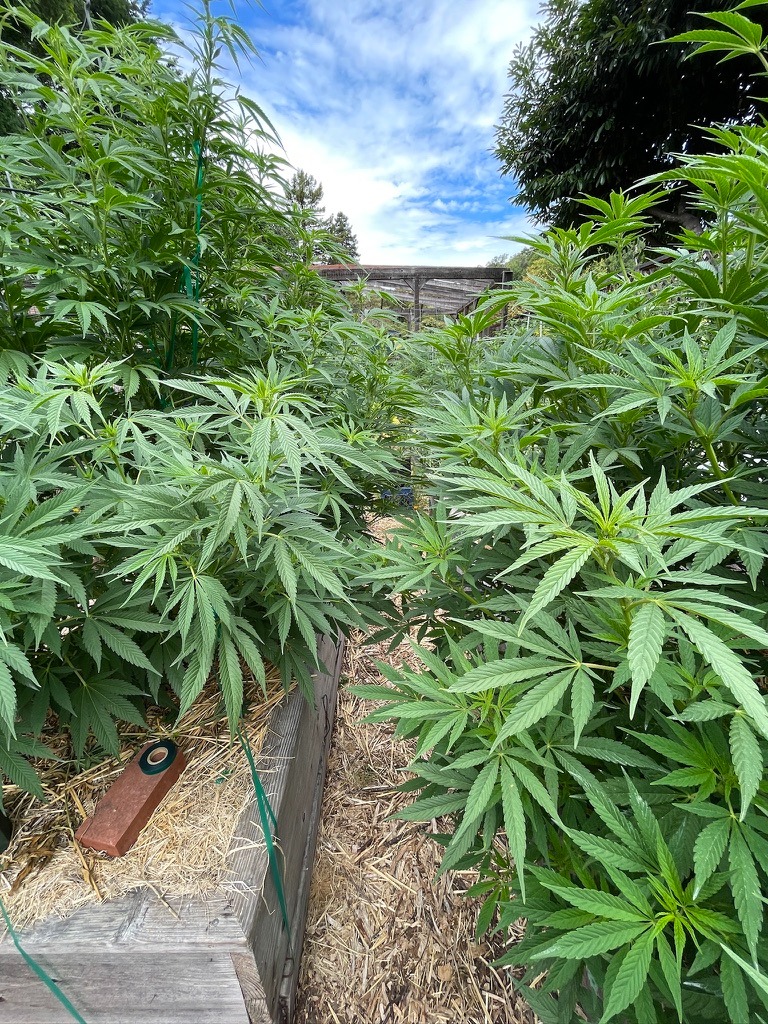
Aisles have become crowded.
In terms of my current grow, the prediction is now for heavier-than-usual rain to begin in October, not November, as originally stated. I thought this grow might avoid it, but now it’s looking like it could impact October.
So as of today, July 13, the supplemental outdoor lights have been turned off. I was going to turn them off July 22, but the plants are plenty large, so we’re sending them towards flowering now. Three plants have already begun to flower: the White CBG in a cloth sack, Rośe in bed 19, and the rapidly growing Banana Papaya in bed 22. This is a direct result from giving heavy doses of potassium and phosphorus in several compost teas in a row. I want this harvest to come in before the storms might begin. Given the health and vigor of the plants, I am determined to bring the crop in before damaging weather hits. Plants have received key flowering nutrients much earlier than in the past. This is pushing my entire crop towards an earlier harvest.
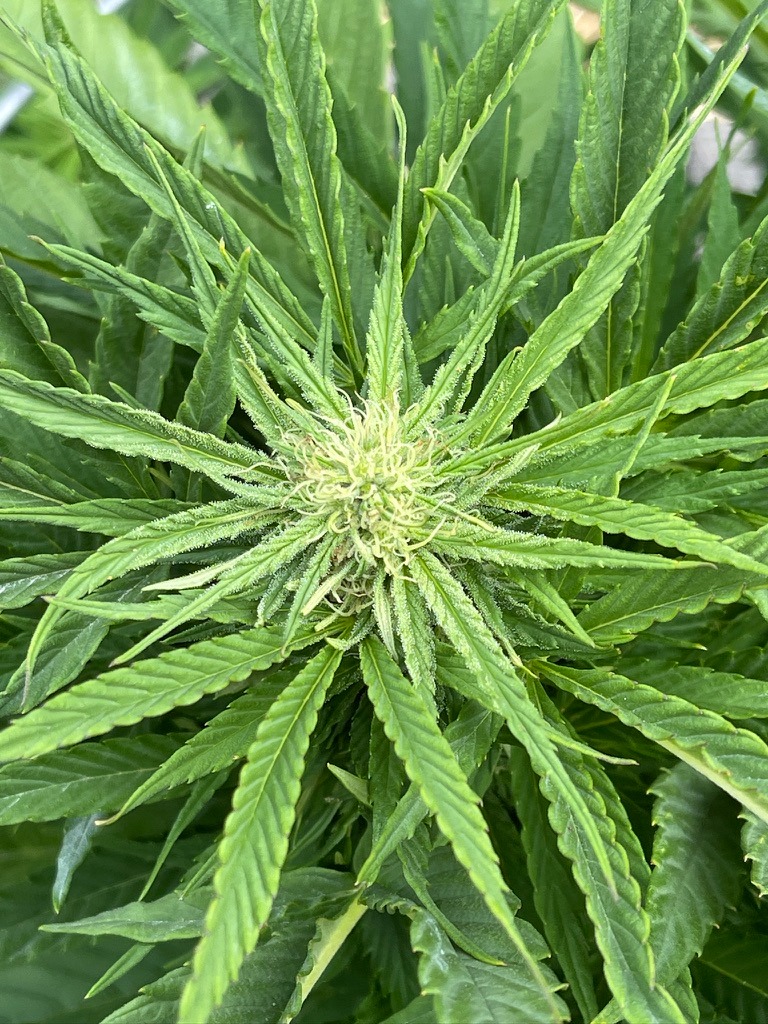
Rośe in bed 19, approximately 13 days into flowering.
Given some of the problems I have faced with plants flowering as late as the end of October, this might be the way I grow from now on.
I am very pleased that Banana Papaya 22 will come down in the second week of September. She will avoid most of the perils of autumn and largely grow her flowers in sunshine, not shade. This is very exciting for that cultivar.
The rest of the plants are all showing pre-flower signs, like the sparkles of trichomes in advance of flowering and the tightening of the tops. I’m basically pushing the plants toward flowering, and given the potential weather this seems like a prudent choice. I’m grateful to have the tools to make this happen.
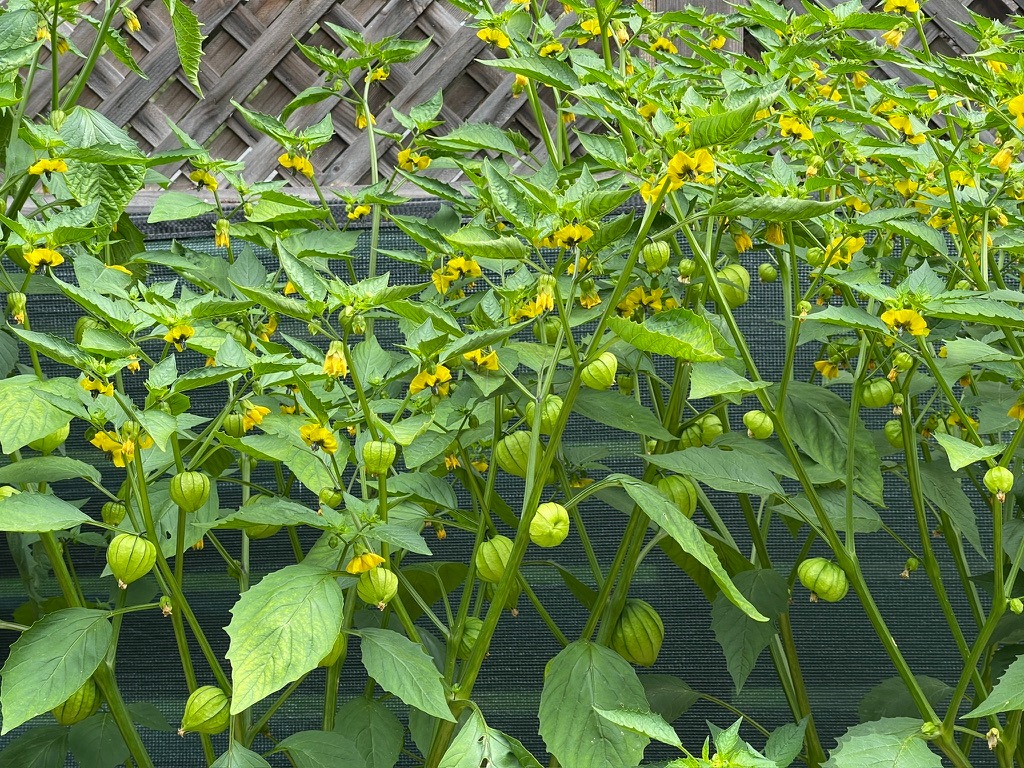
I laughed earlier this morning when I stood by the tomatillo plants that are above my head and said, “No more nitrogen needed this year.” Which also means that all guano collected for the rest of the season will be dried and put into jars, for use in years ahead. It’s been a productive summer for our bats. I’ve literally been collecting, drying, and using the guano captured this year. I’m saving older jars of guano for use over the winter.
I’ve written this before, but I’ll write it again: If you put up a bat house and there are bats in your area, they will come. It’s a free source of guano and nitrogen. Collect enough and you won’t need to buy growing formulas. Make sure you wash your hands if you’ve handled raw guano.
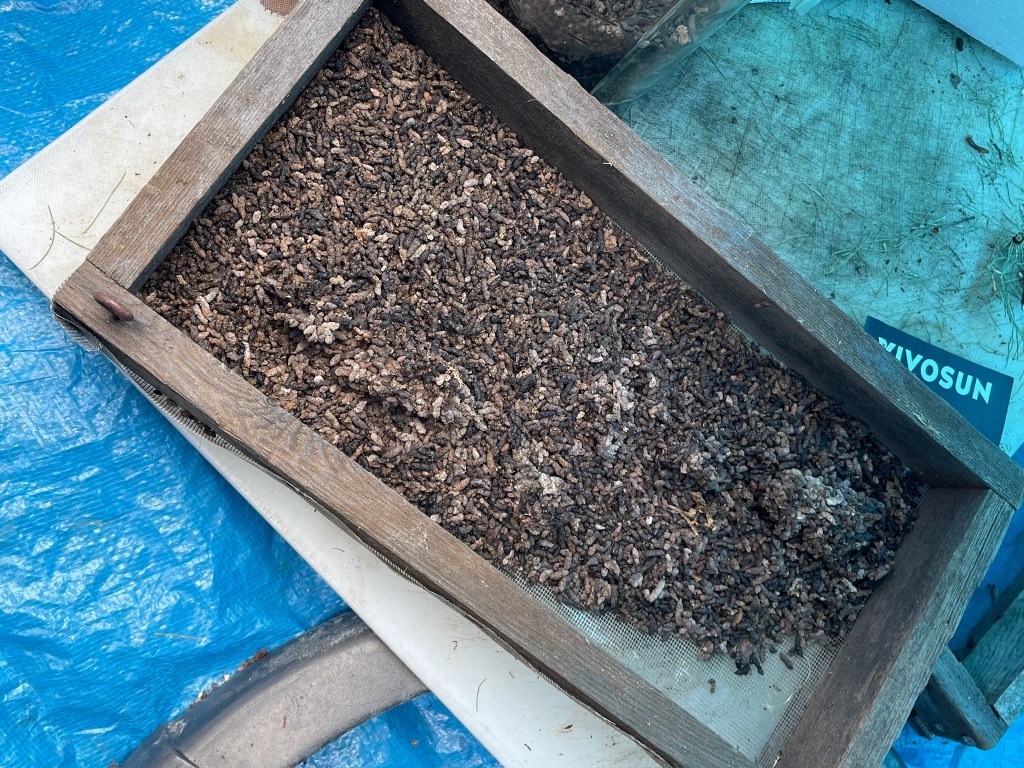
Foliar sprays are proceeding per normal. Monday is Regalia, Tuesday is either Grandevo or Venerate (they alternate weeks), Wednesday is for Dr. Bronners, if needed, Thursday is for Stargus (three plants currently), and Friday is Neem, if needed.
Compost teas are being made on Thursdays and poured on Saturdays. There was one week where I made two batches of compost tea because the cannabis and vegetables required different ingredients. By that, I mean that the vegetables needed Bloom formula while the cannabis was still in vegetative mode. But now, the majority of tea is for cannabis. Vegetables have had enough and only need about one tea per month for the rest of the season. The majority of work needed from compost teas has been completed. Our soil is very happy.
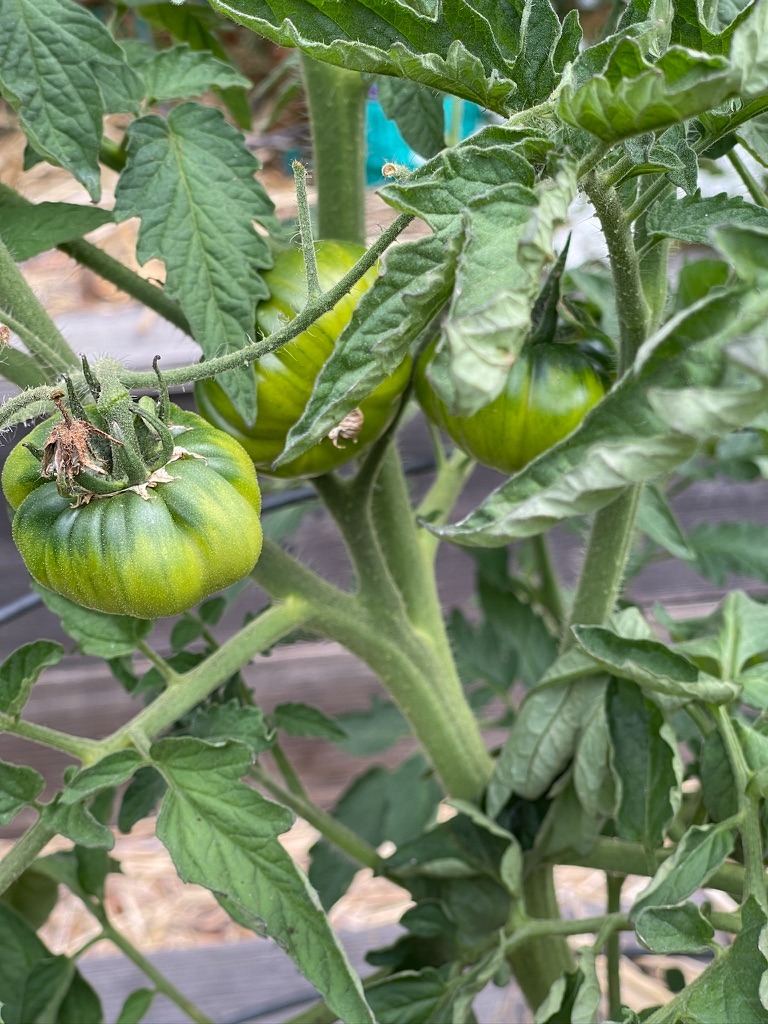
Russian Black Krim tomatoes taking shape.
Btw, cannabis isn’t the only plant that is no longer being watered. All five tomato plants are being starved and are showing no signs of strain. They just keep producing more flowers. There are hundreds of tomatoes waiting to grow in our garden this year. The Czech Stupice heirloom has over 200 flowers visible, with more buds coming. In a few weeks tomatoes will start coming in, which will continue until after the first hard frost in November. We should have our first guacamole of the season in about two weeks and may still have fresh guacamole with these sweet tomatoes on Thanksgiving.
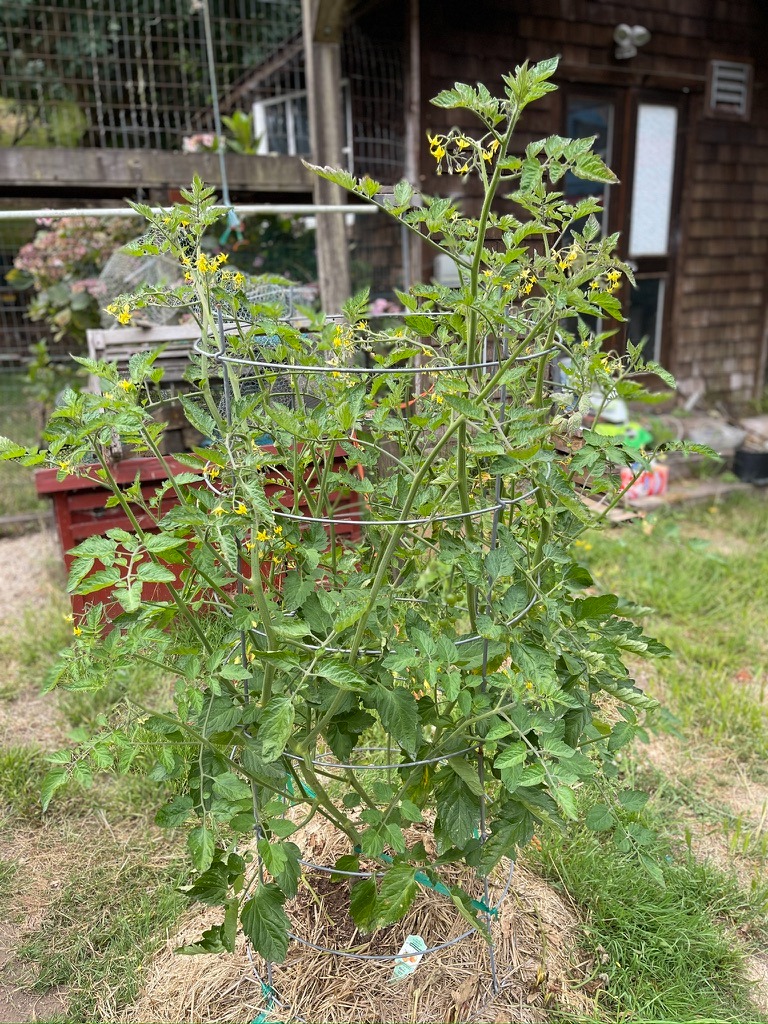
This sungold cherry tomato plant is almost six feet tall.
Tomatillos are exploding too, mostly over my head. This means buckets of pozole, which I honestly cannot get enough of during the winter.
To date, there has been no pest outbreak, and only a few flea beetles have been seen.
I am of the belief that last year’s infestation was a result of the weather. It was humid the entire summer and this caused a different and surprising pest (flea beetle) to emerge.
This year, temps have been routinely 68-78 degrees (20-25.6 C), with humidity hitting between 50 and 60 percent. It has been an ideal summer of growing. Foliar sprays, companion plants and a more normal weather pattern have limited any potential pest or pathogen outbreak. It’s a clean grow so far.
I wish I could stretch it out a bit and see how big I can grow the girls, but the weather is telling me to curb my ego and do what is right for the medicine. So it’s going to be an early harvest and we’re perfectly fine with that. It’s going to be a decent yielding crop, perhaps over ten pounds. I suspect that subsequent crops are also going to be larger. I have finally dialed in the timing to grow, aided by the supplemental outdoor lights, which are now off and will soon be stored for winter along with the timers. Those timers will be saved for the outdoor lights.
Next up will be a thorough cleaning of the drying cottage. It’s time to take everything out and place it on a tarp. Then, I vacuum and mop a couple of times. Once the room dries we bring in what we need for harvest. I’ll put up new strings to hang the harvest.
As of August 1, we should have a small, cloth-grown CBG plant to wash and dry. After that, the main harvest will be in September. It will be a busy fall of drying as I handle both my own crop, plus a whole bunch of CBG and CBD being grown by another grower at another farm for us to turn into medicine for friends in need. The plants will be brought to us for cleaning, drying, processing and eventually, testing. I need my drying cottage working at peak power.
July 20–Ten of the twelve plants are now flowering and I expect the other two will turn before the end of the month. The other two are Cherry Punch 18 and Rośe 21. Cherry Punch looks like she’ll turn by this weekend. Rośe looks like she’ll need another week. For the first time ever, it looks like my cannabis and hemp harvest will be completed entirely in September. It seems that I will avoid harvesting in October at all, and will turn my attention then to trimming and testing.
This is significant for several key reasons. It’s very cool that I might avoid potential early storms by harvesting earlier, and that I can make this change with compost teas and light management. My compost teas have been rich in potassium and phosphorus for the last six weeks, with this exact outcome in mind. Until this year, I’d never consciously planned for every plant to be harvested in September and it brings a couple of obvious advantages into play for the crop.
First, an earlier harvest means more sun on the plants during the flowering process. Plants that didn’t harvest until mid-late October were getting no more than about four to six hours of sun late in the cycle. In September, they will still get eight hours plus. This is significant for trichome production. Perhaps even more important for us will be a reduction of potential pathogenic problems. While October can be a challenging month for pathogens, September means late summer heat and sun, which means less powdery mildew, which in turn means I’ll be able to safely spray BT whenever needed. Because BT and Regalia conflict with each other, it’s best to give each product a full week before using the other. I’m going to start BT soon, while I have no need for Regalia, and see if I can put some measure of control on the moth worms.
One final cool factor in an early harvest: There is a greater likelihood that all our plants will grow to their true harvest date. Because the harvest itself is a month earlier, the plants should get the benefit of their full flowering cycle.
You may remember that last year most of my crop came two to three weeks early. We had spectacular test results, but I’ve wondered ever since how much more potent that medicine could have been with two to three more weeks of time in my beds. I don’t see anything preventing our plants from their full flowering cycle this year.
For all of these reasons, plus the fact that it’s a dry grow, this is a very exciting crop for me. Last year was a difficult grow, with significant pest and pathogenic challenges that impacted the size of our yield. This year is a joyful grow with minimal problems. I’m not going to allow the potential El Niń́o to negatively impact this crop. Instead, this epic weather forecast is pointing me in the direction I’ll probably grow in the future.
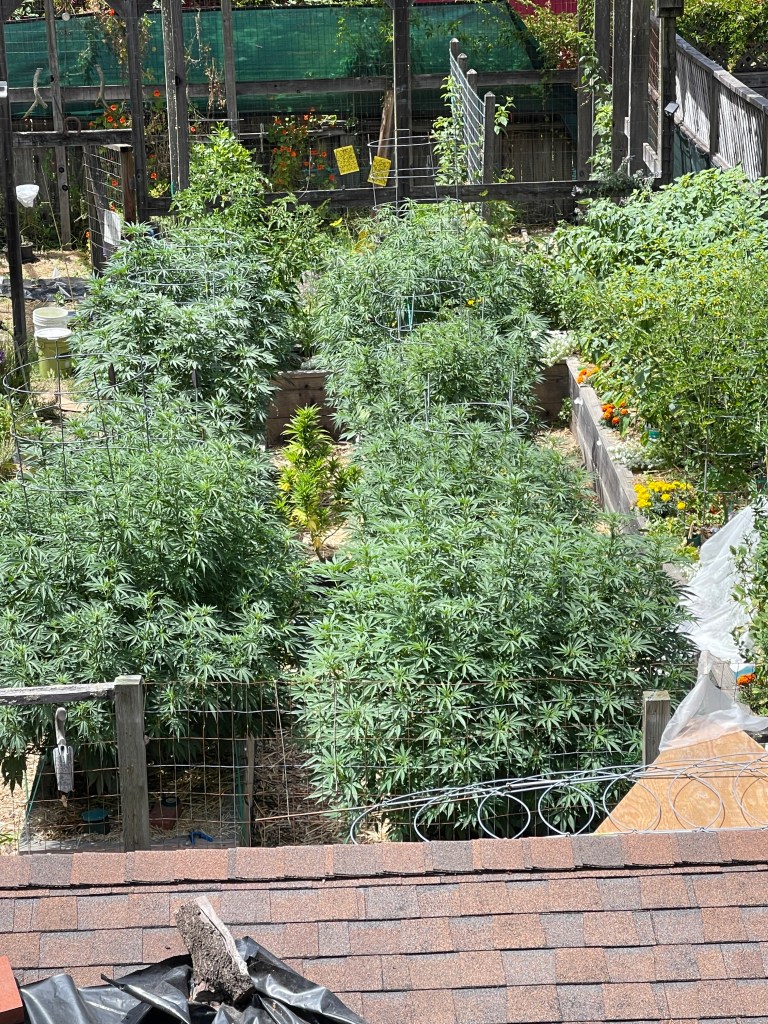
With a potentially extremely wet winter, I decided to see if I could bring my entire crop in early without sacrificing quality or potency. Next year we’re liable to have an abundance of water which I’ll only use on plants other than cannabis and hemp. This year’s grow is reminding me that my need for water to grow plants is minimal. As a cannabis grower, that is not how I was taught. But thanks to our miraculous mycelium, that’s where I am.
July 21–We received about 0.05 of rain this morning as monsoonal remnants passed by. Moth worms have begun their annual period of egg laying on my plants. A BT spray is coming this afternoon.
So . . . this year is turning out to not only be a dry grow year, but also the year I finally master how to grow for an earlier harvest. It will be interesting to compare how much mold we see, when compared to other years. My guess is this is going to be among our least moldy years, which is in direct contrast to last year, which was one of our worst.
Delightfully busy with gardening, writing, and especially, another month with Misty.

Survive and Vote. See you next month with flowers and fruit galore!
Hey Friends: If you’d like to support jeffreyhickeyblogs.com, please feel free to contact me directly with your ideas (good seeds are always welcome–and if I grow them, I will get the flowers tested and share with you the results.)
Disclaimer: The majority of the links in jeffreyhickeyblogs.com posts are affiliate program links. This means that (most of the time) when you purchase a product linked from my site, I receive a commission, which helps support the blog.


Leave a Reply