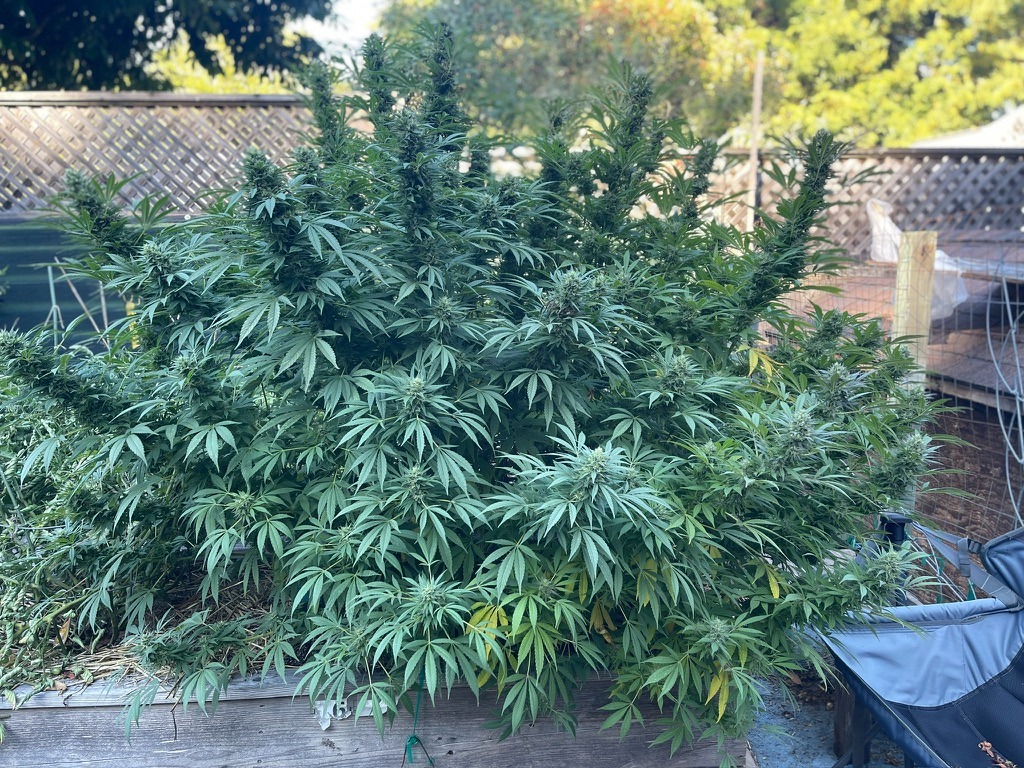
Harvest morning for Love Lucy 16, the largest plant I’ve ever grown, 1,610 grams, 3.54 pounds, 1.6 kilograms.
The 2026 grow, my first ever complete dry-grow, will be remembered as my benchmark year, the crop all others will be compared to. I yielded 17.25 lbs (7.82 kg) for a backyard grow, my largest yield to date.
As anyone who has been following my blog this season knows, this crop marked a distinct change in the way I grow. I’ll only dry-grow from this point forward. I realize this separates me from virtually everyone else, as I don’t know anyone else who grows this way at the moment. I have to wonder, though, how many other growers could do what I’m doing, if only they took the time to discover whether there might be a fungus colony beneath their grow.
When my plants first sprouted in the cottage, they received all the water that they needed. After five weeks, the plants were placed in raised beds, where they received water one day a week (Saturday) for the first three weeks. At that point, I determined that the plants were large enough that the tap roots should have reached the mycelium beneath my beds. After that, they received a quart of aerated compost tea weekly until the last three weeks of flowering. Then: nothing. No water or compost tea. I had ten plants in beds and two in cloth sacks. Neither of the sacks produced much cannabis and Rośe 19 was a very small plant. Those three plants only accounted for 0.82 lbs (0.37 kg) of the entire yield. The majority of my yield this year (16.43 lbs 7.45 kg) came from nine plants. That’s 1.82 lbs (0.82 kg) per plant. I used to think that averaging a pound per bed was a good goal. The largest plant, 3.54 pounds, (1.6 kg) was more than three-quarters larger than the second largest. I no longer know how high my ceiling resides. This crop was as close as I’ve come to a perfect grow.
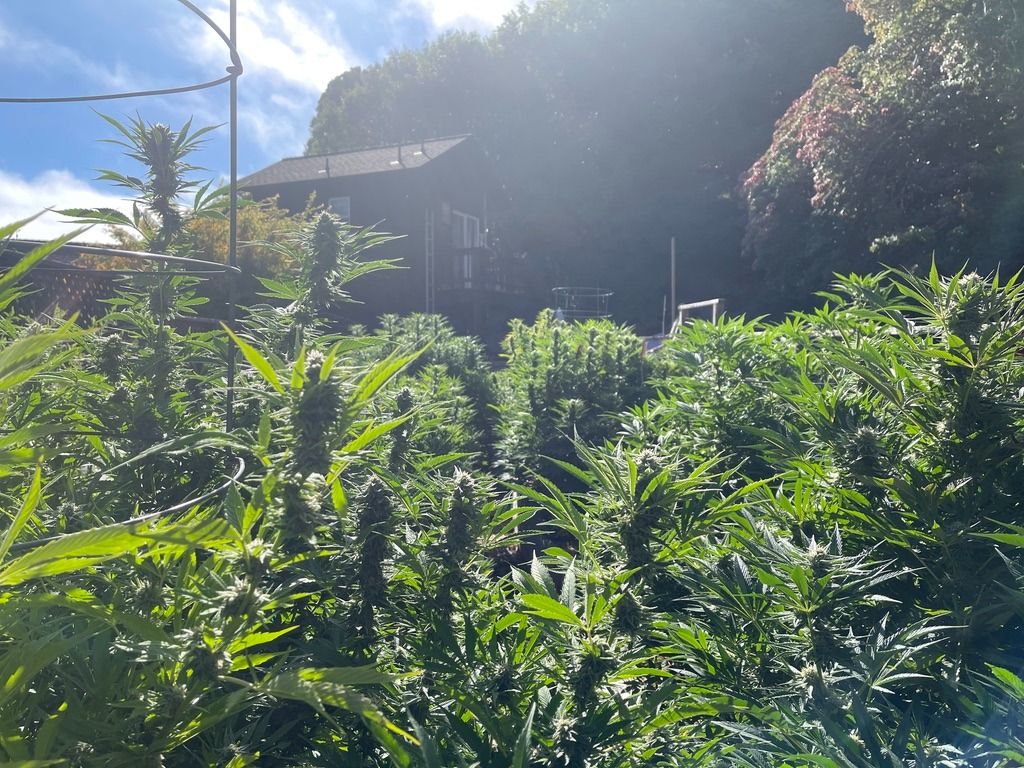
We were helped by great weather, the best I’ve had to grow with since 2020, the year I began this blog. It was also the last year of crop yields over 13 lbs (5.89 kg). Since that year, weather has been a major issue. My crop yields had dwindled down to only six pounds and seven pounds, the last two years. My dispensary needed an infusion of material. I needed a large grow, and when I noticed how perfect the weather was maintaining through summer solstice, I told Bee that we were going to do minimal pruning and aim for a high-yield harvest.
This was risky, of course. High-yield harvests are high-risk harvests. If something goes wrong, a lot of plants could be affected. For example, if a flea beetle infestation had hit any of our very large plants, we could have lost chunks of them to mold. That has happened before.
But the weather maintained a near-perfect level for almost the entire time the plants were in the ground. The exception was one September rain, when we received over eight-tenths of an inch, enough to cause some pathogenic issues.
This is where it got interesting, and rather definitive for the future.
Because we opted for a high yield grow, we did not prune as much as we normally do. Ordinarily, we take out a lot of inner growth that isn’t going to produce great flowers, and allow all the energy to go into the larger buds. This is standard operating procedure for a grow. But this year, we left most of the inner stuff on and watched it reach out for the light it needed. As a result, we had large plants with lots of flowers on very long stems.
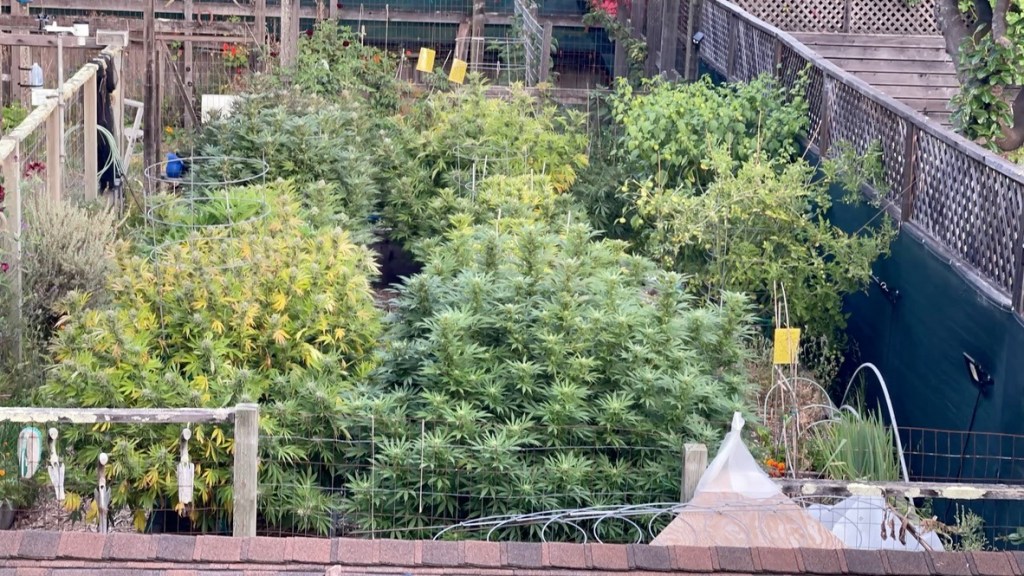
In this photo, you can visually tell which plants will come down the soonest by the number of yellow leaves. Those plants have been cut off from water by the mycelium in the final days, and are draining every bit of liquid from the remaining fan leaves prior to harvest.
I trusted that my regiment of foliar sprays could hold both insects and pathogens at bay. For the most part, my trust was validated. I also used a different method of introducing two of my sprays to the crop. I made a foliar spray of Regalia and Stargus and just before putting my five-week-old plants into their beds, I dug the planting hole and then soaked it with that spray. Then, I planted, allowing the roots to drink these substances, rather than only absorb them via spray.
Consequently, we barely saw any powdery mildew the entire growing season. Our mold was minimal, and mostly typical of Stargus mold, which is to say, it grew away from the flowers and was easily removed, without any residue remaining. As for Regalia, I sprayed once a week for the first month and then not again after. Because I did not need to use Regalia beyond that first month, I was able to use BT on a weekly basis for a month during the early stages of flowering. This was instrumental in limiting moth worms, the scat they produce, and the mold that it causes. There were still a few worm molds, less than two dozen for a 17 pound crop. And we only had to carve off less than two percent of our entire crop because of botrytis. For an outdoor grow, that’s virtually mold free.
We did prune some, of course, but we endeavored to prune mostly in a certain way. We used scissors to cut off leaves on most plants. We tried to avoid using our fingers to snap off fan leaves. Sometimes, that works. We all do it. But sometimes, the fan leaf snap will strip some bark, and if you don’t cover and seal that strip with honey, the door is open for pathogens and/or insects to strike. Flea beetles will invade under the skin of stripped bark. They burrow in and protect themselves from foliar sprays. They spread their scat and mold begins, first appearing as stem rot.
Here’s where it gets interesting. Pathogens need moisture for fuel and I wasn’t giving the plants any extra moisture. The weekly compost tea of a quart was not a bed wetter. The beds were bone dry. Without moisture, mold doesn’t have a way to activate and travel.
But as soon as that eight tenths of an inch of rain fell, every plant that had some stripped bark quickly became eligible for stem rot. It did not impact every plant, but it impacted a few. That was the only serious mold that we faced this year.
On the other hand, there were certain plants where our growing discipline was rewarded. On the two largest plants, Love Lucy 16 and Banana Papaya 22, we did not strip bark. Bee and I reminded each other to remain mindful of our giant plants. We cut leaves, leaving slight stems still attached, that eventually dropped off.
Consequently, those two plants, weighing 3.54 pounds (1.60 kg) and 2.77 pounds (1.25 kg) respectively, did not have more than two or three small pieces of mold. They were gigantic, clean plants. Pristine flowers. We did find the full remains of one flying termite. It had miraculously survived the dragonfly field, but her feet stuck to a sugar leaf, unable to escape, in perfect condition.
In the future, our goal is to eliminate snapping off a single stem. It will be scissors only for all pruning. The evidence could not be more clear. Without our careless strips, our plants would have been entirely pathogen free. Dry beds do not encourage either pathogens or insects. Once my beds were dry, about the second week of June, I could take away the beer traps, because slugs don’t crawl across dry soil. The lack of water is a solution to almost every outdoor growing problem.
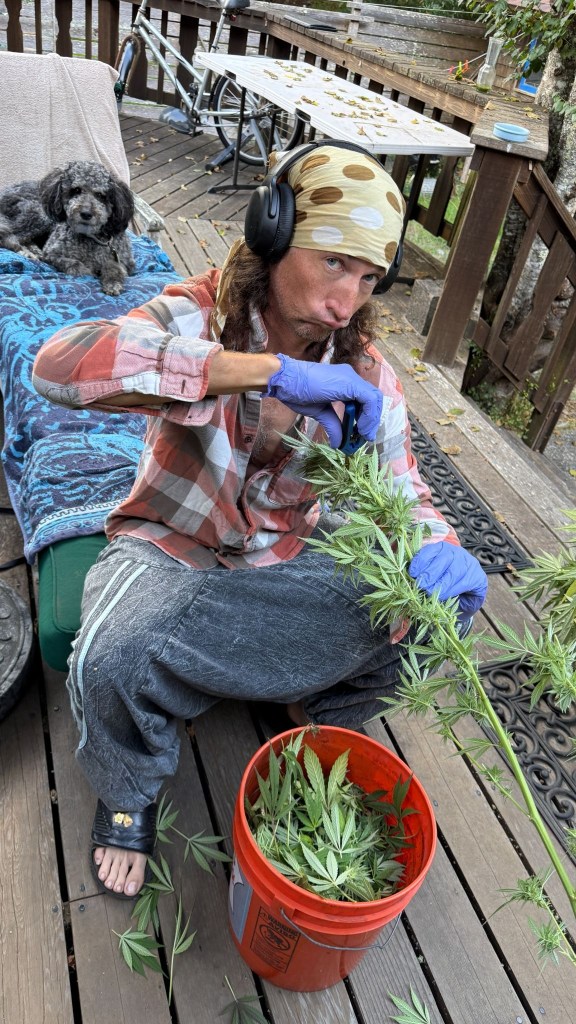
Much love to Bee for all their help, and to Misty, for being my bestest girl.
Going into this grow, my home dispensary was getting low in some key areas. We needed a CBD boost and we grew over five pounds. We needed more CBG and we grew over two and a half pounds. We needed some new sativa hybrids and we got over four and a half pounds from the two Banana Papaya. These are all plants whose buds will last for years, and will be our bell cow plants for guests, while we build a stable of variety around them. That’s what next year’s grow will be: Fun Stuff. More on that later.
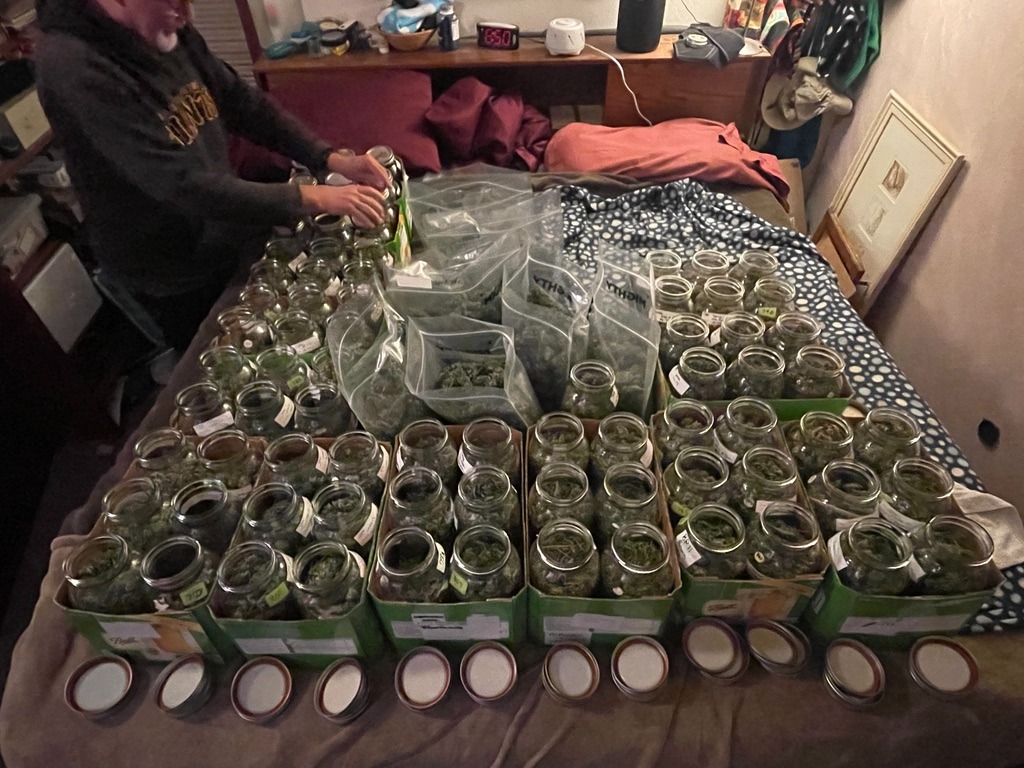
I had to use a different kind of “raised bed” for burping. It was easier on my back.
This grow took me out of mason jars. We had 80 half gallon jars to use and it would have taken 99. The last plant, the largest, would have taken 21 jars.
I’ve been singing, “99 jars of weed on the wall, 99 jars of weed, roll it up and smoke it down, 98 jars of weed on the wall. 98 jars of weed on the wall . . .”
For Love Lucy 16, we weighed her in jars, but stored all of her medicine in sealed plastic bags. It’s all going to be turned into FECO (Full Extract Cannabis Oil) soon enough, so storing in these bags seems perfect. I think all my CBD and CBG will go into bags in the future and save the jars for the A-trim and popcorn.
Speaking of which, I know many of you out there only include A-trim when calculating your grow’s final weight because that’s all you use. We use everything that has trichomes on it, so that’s what we include when calculating our count. Our popcorn is potent. But we still managed a huge amount of A-trim this year. In Banana Papaya 22, she produced more jars of A-trim than of popcorn. That was true for several other cultivars.
For example, the supreme seed of OG Kush produced just under two pounds. I was not expecting that much, but as a new, powerful potential sleep plant, it checks the box for another need in our dispensary. She has already knocked me out just from smoking her. I also wanted to mention this seed because of the gratitude I feel toward the reader who sent it to me. It came from a great source, Royal Queen Seeds, and it was an honor to grow this classic. She was beautiful, too. Thank you, Phil. Much appreciated.
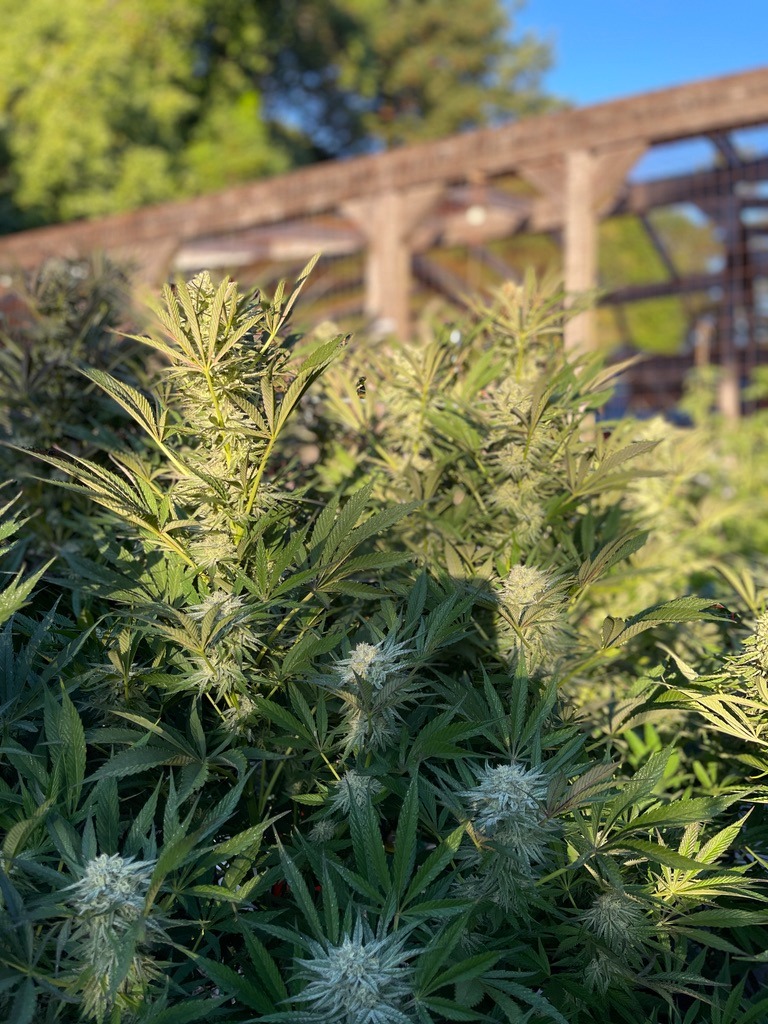
OG Kush 17
I am looking forward to reading the test results. They’re coming, but right now, while I’m writing this, it is October 16. I won’t send in samples until October 22 or have results until the 25th or 26th. Once I have those, I’ll finish this blog and publish.
I have no idea what to expect. My first dry-grown plant was last year, a Cherry Punch that grew to 29.68% THC, my biggest THC score to date.
But she was also grown in a more typical fashion of pruning off the weaker growth in order to serve the strongest.
This year’s grow was done for yield, so I might be sacrificing some potency for a higher yield, a trade that I’m happy to make this year. Next year, we’ll grow for variety and potency. This year, we grew to fill the closet. That said, I cannot wait to see what the potency will end up being across an entire large crop grown without water.
So, I’m going to pause writing this until I get the scores.
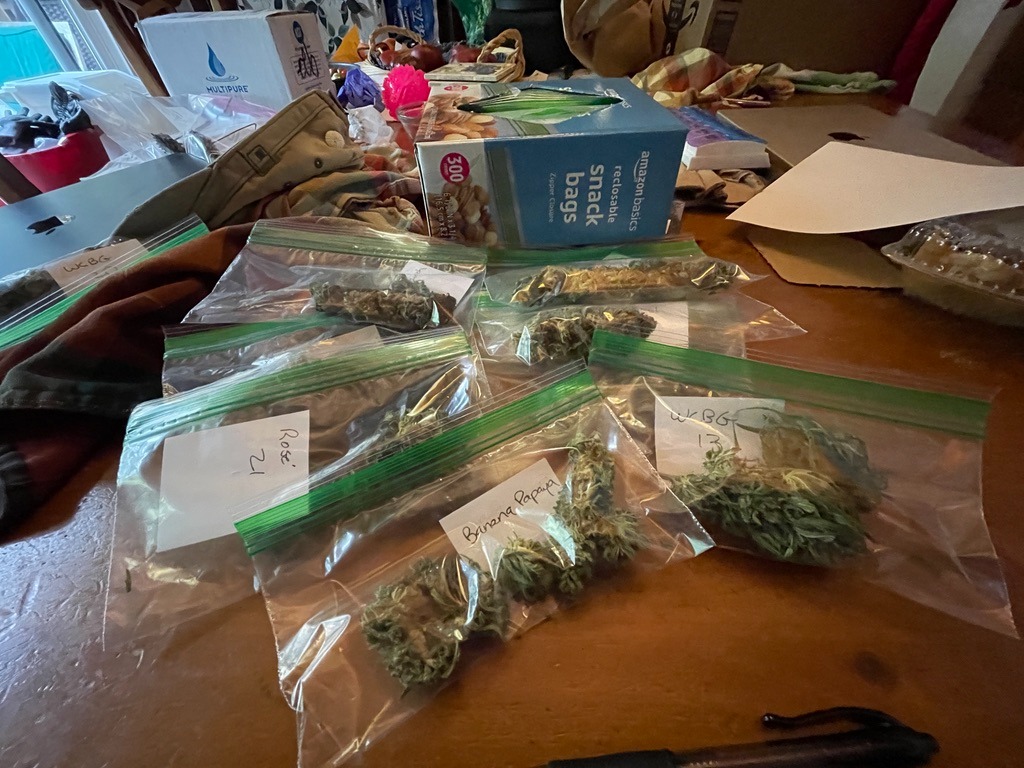
It’s October 21, and there are ten 5-gram samples awaiting a courier tomorrow for testing.
The 2026 Test Scores:
Total Grams: 7,826
Total Pounds: 17.25 (7.82 kg)
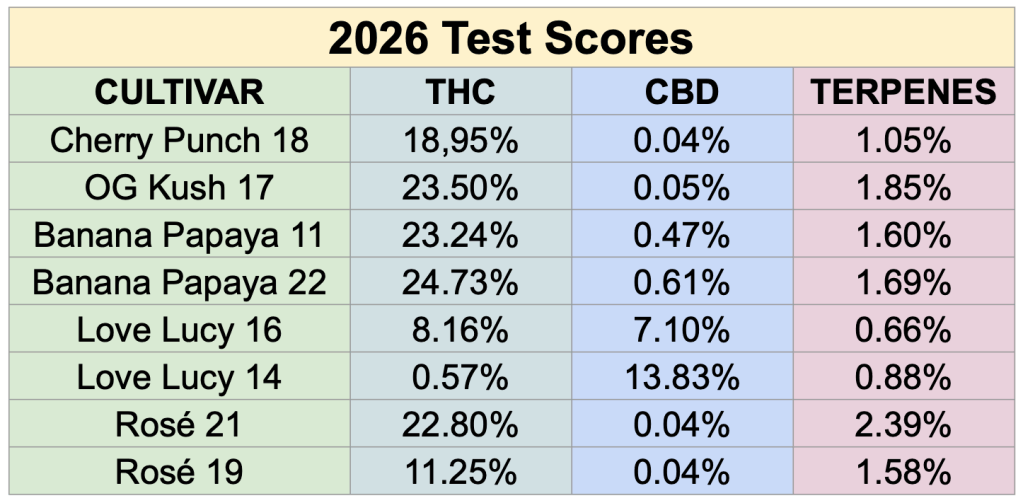
There are some confirmations in this group and some surprises. All of the THC plants would have been even more potent had we pruned more. But at 22-24 percent, these are fantastic scores for plants this size. The biggest surprise for me is the score for Love Lucy 16. I grew a CBD bomb. She is a 1:1.5 ratio of CBD to THC. This plant will get you stoned and help your pain. The other CBD plant, Love Lucy 14, is more typical, with a 24:1 ratio of CBD to THC. Won’t be getting stoned on that plant. CBG scores were lower than I expected at 11% (not shown), but that’s still a good score for effective medicine; especially when concentrated and then combined with CBD.
I did not have a monster score this year. Just consistently excellent scores and little to no pathogenic problems. A great combination. Consistent scores, with a couple of bombs thrown in. Banana Papaya 22, in particular, is a fantastic plant, from my point of view. Her terpenes feature the classic one-two punch of Beta Caryophyllene and Limonene, with Humulene in third. This means there’s no anxiety in this plant, no paranoia. This means it will stop any nausea you might be experiencing. And with Humulene, this plant will NOT be as munchy oriented as others, because Humulene is an appetite suppressant. This is one of the most perfect plants I’ve ever grown.
The bottom line on my 2026 grow is that I dry-grew my largest harvest ever. I did not expect that, but am thrilled to have grown such a large crop on my first full dry-grow attempt. I did not have any 29% plants, but that was largely because we didn’t prune away the excess. We grew for yield and we were successful. To grow a nearly three pound plant at well over 24% is a beast. We’ll be enjoying that plant for years.
It will take me weeks to study these tests and completely understand them, but everything I’ve seen so far supports the changes I’ve made in how I’m growing. For me, there’s no going back.
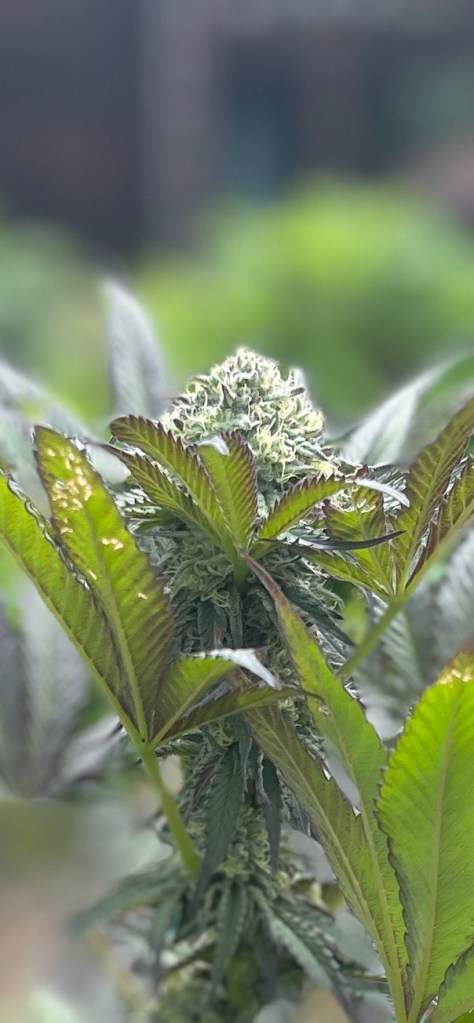
Because of the success of this year’s grow, next year is going to be a blast. I won’t have specific needs to grow for, so Bee and I will decide on a variety of fun choices, cultivars we’ve never tried, with new genetics. We’re thinking of growing our first pure sativa plant, for microdosing. We’re looking at some strains that we haven’t grown yet, like The Purpz. There are many others that we’re considering, and while I don’t yet know everything that we’ll be growing, I already know that the pressure is off. Next year’s crop will be a fun group of plants, with hopefully lots of color.
Whatever we grow, it will be dry-grown again. And yes, I’ll blog the grow, similar to what I did this year, because I’m still going to be busy writing the next novel.
Finally, before I disappear for the winter, I would like to welcome all the students from China, who recently began studying my entire blog. Please feel free to ask any questions. I will respond asap.
See you next year.
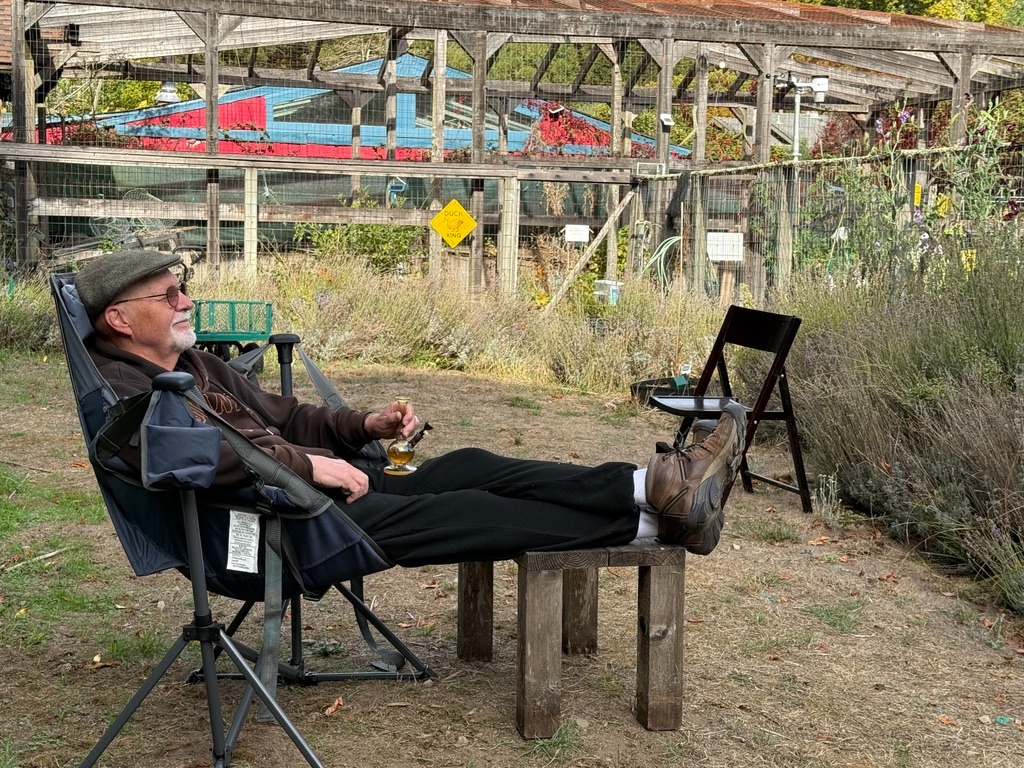
One last reminder: Survive and Vote, please.
Hey Friends: If you’d like to support jeffreyhickeyblogs.com, please feel free to contact me directly with your ideas (good seeds are always welcome–and if I grow them, I will get the flowers tested and share with you the results.)
Disclaimer: The majority of the links in jeffreyhickeyblogs.com posts are affiliate program links. This means that (most of the time) when you purchase a product linked from my site, I receive a commission, which helps support the blog.


Leave a Reply