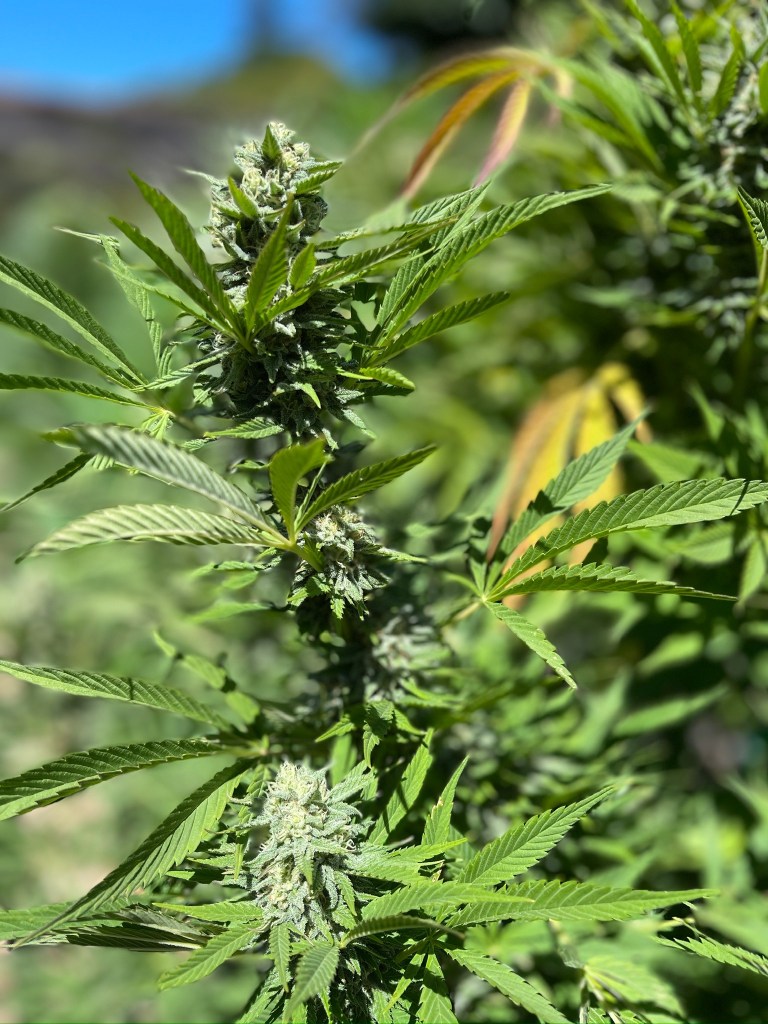
Banana Papaya 22 about three weeks from harvest.
We are deep into flowering for the plants in the dry grow. There’s been no stress from a lack of water. The last time they received water was May 25. Weekly quarts of compost tea will continue for a few more weeks, with plants being cut off from even that three weeks from harvest. The teas are very basic now, just molasses, humic acid and SEA-90.
My guess is the first large plant to come down will be Banana Papaya 22, between September 10-15. After that, it should be every couple of days for the rest of the month, with two left for harvest in early October.
There’s been less pruning than usual this year. I still might prune some, and definitely will if conditions dictate. But this grow has been under what I consider to be more “normal” weather for Marin County. The size and health of the plants reflect this. For the first time in several years, the opportunity exists, to harvest a ten-pound-plus yield. It’s nice to get a few larger harvests in the closet to create an effective home dispensary. So I’m allowing some flowers to develop that might be cut off in other years. There will be extra popcorn.
My largest harvest ever was over 17 pounds. This won’t be close to that, but it will be over ten pounds, which I consider to be a decent-sized yield for a home grow. By comparison, even though last year’s test scores were the best ever, I only yielded a little more than seven pounds.
Harvesting more than ten pounds keeps the dispensary happy and allows me to keep my family and a few sick friends in free medicine.
So I’m excited about the remaining flowering plants. Both Banana Papaya are large, BP 22 is the largest plant in the beds this year.
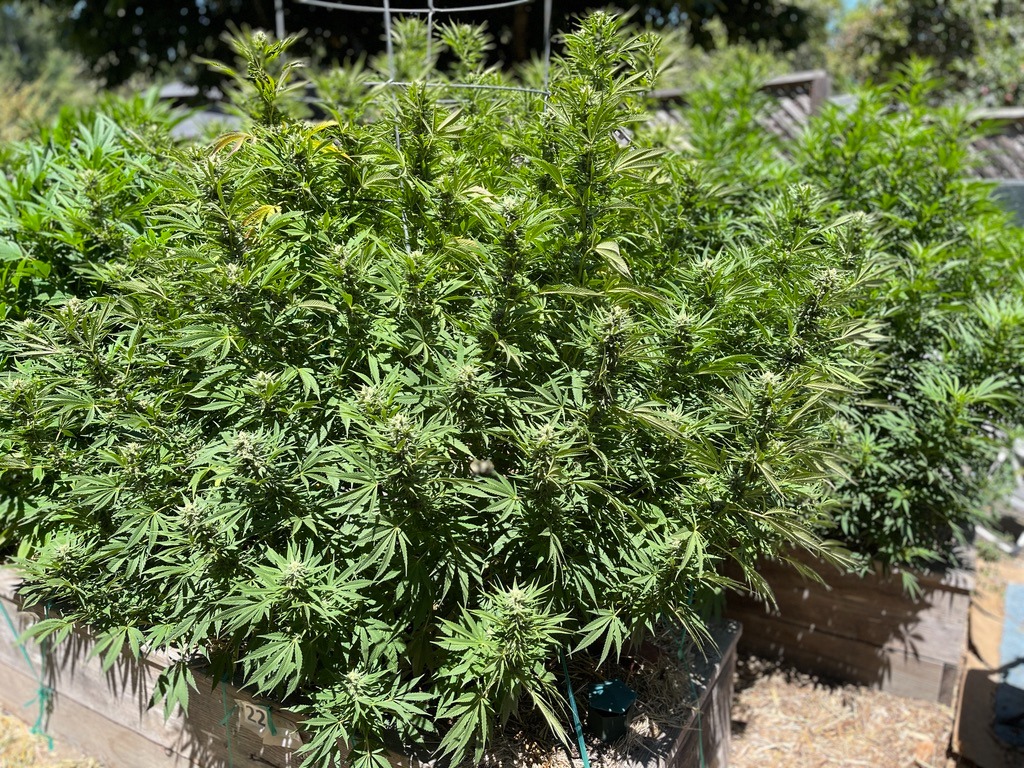
BP22 with three weeks to harvest.
Both of my Love Lucy CBD plants are large too, with LL 16 looking like a plant well over one pound.
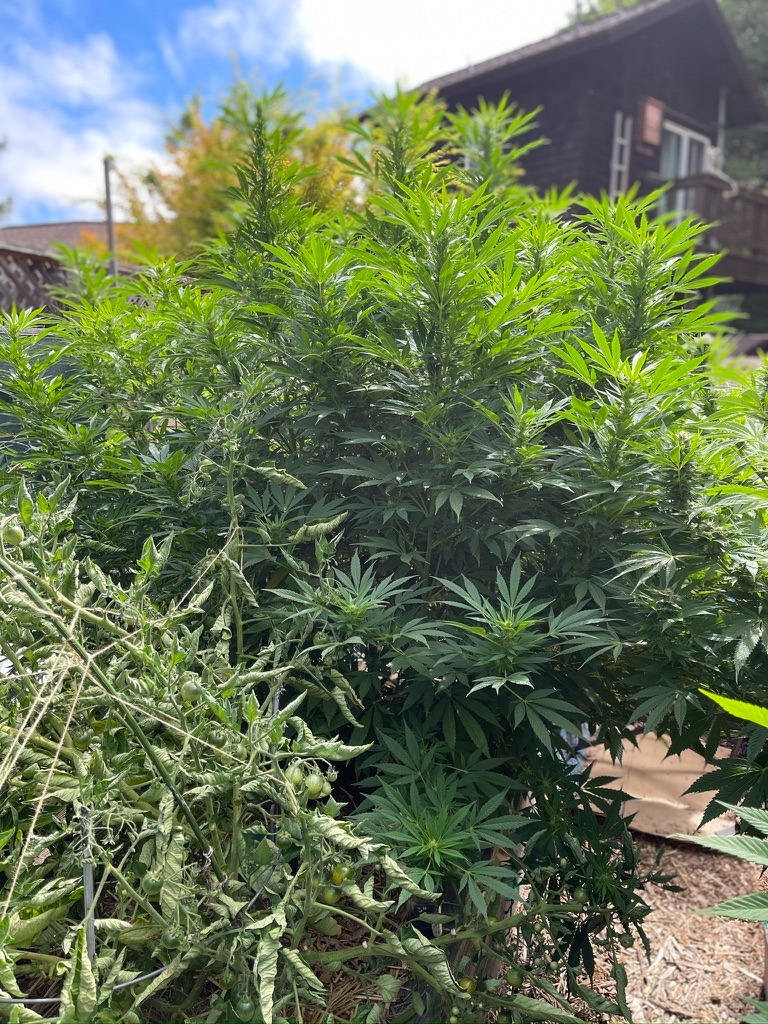
Love Lucy 16, partially obscured by a Czech Stupice heirloom tomato plant.
The same can be said for both White CBG, with WCBG 20 being the largest CBG plant that I’ve grown to date.
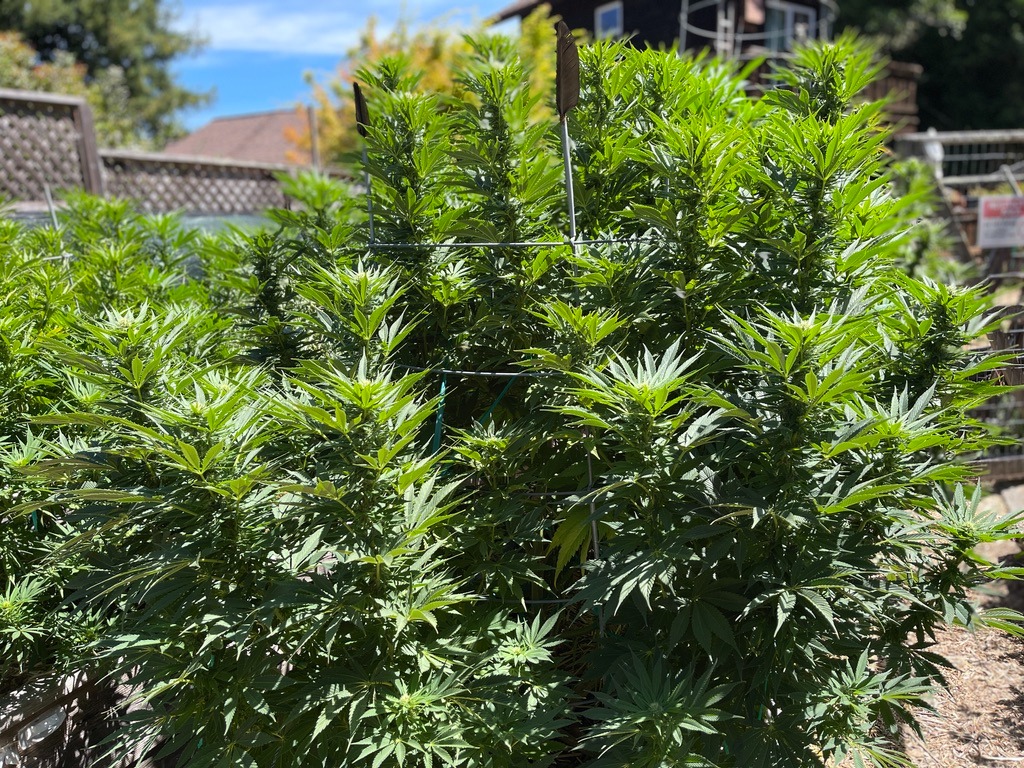
WCBG 20
Meanwhile, OG Kush 17 is looking phenomenal. I’ve never grown this classic and I can’t wait to try it. This is a marvellous example of the cultivar, a flawless-looking plant, and should yield well over a pound, more than I was expecting. As a bonus for me, it’s nice seeing bed 17 produce a large plant again. She’s had a couple of dud years. She was also infested with flea beetles last year, so obviously our eradication efforts have been successful.
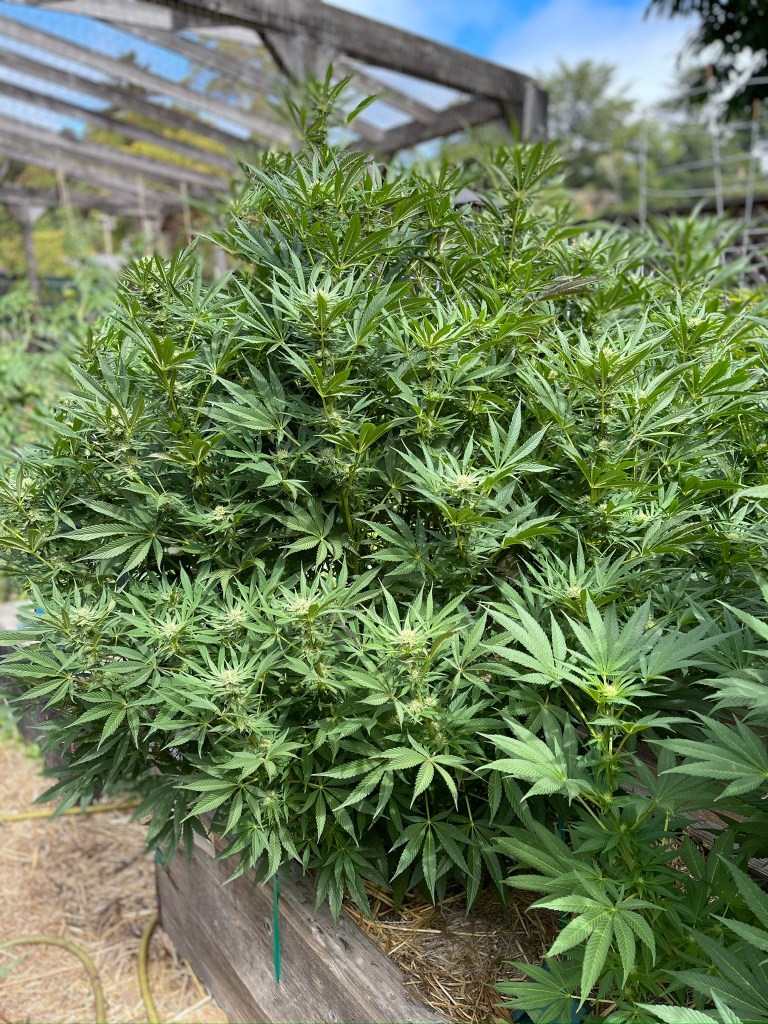
OG Kush 17–a virtually flawless plant.
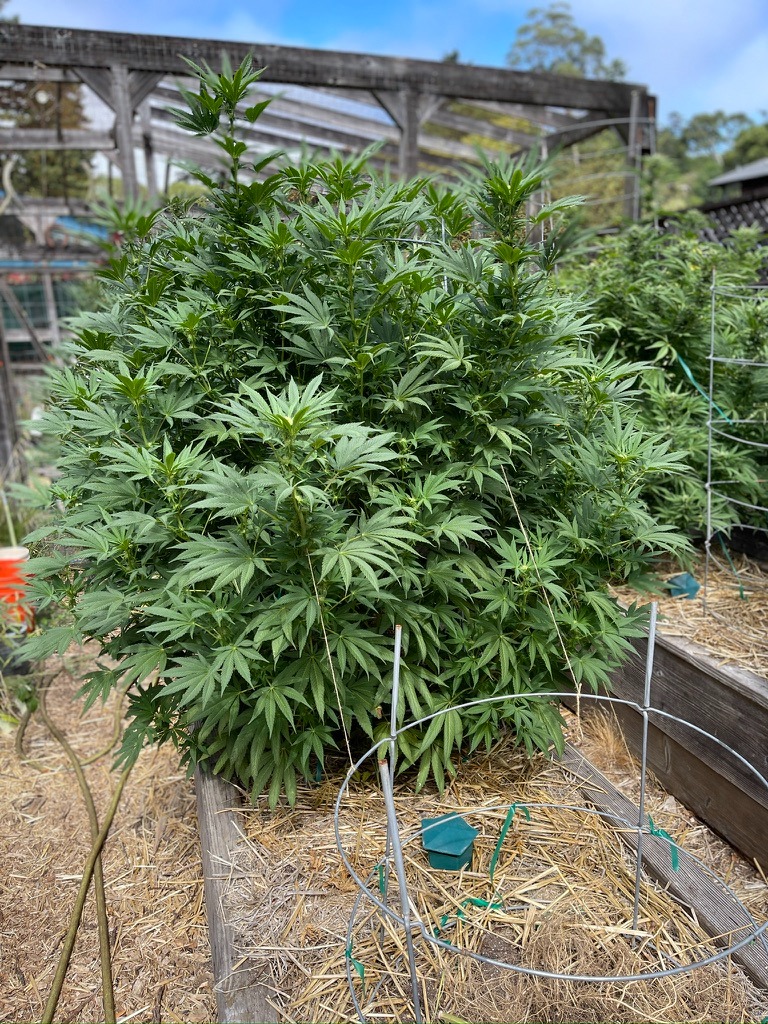
Cherry Punch 18 is very healthy, too.
Cherry Punch is not a giant like last year, but not every seed is a giant. She’s large enough, another pound I would reckon. She is still growing and will be the last to harvest. She is fully flowering now.
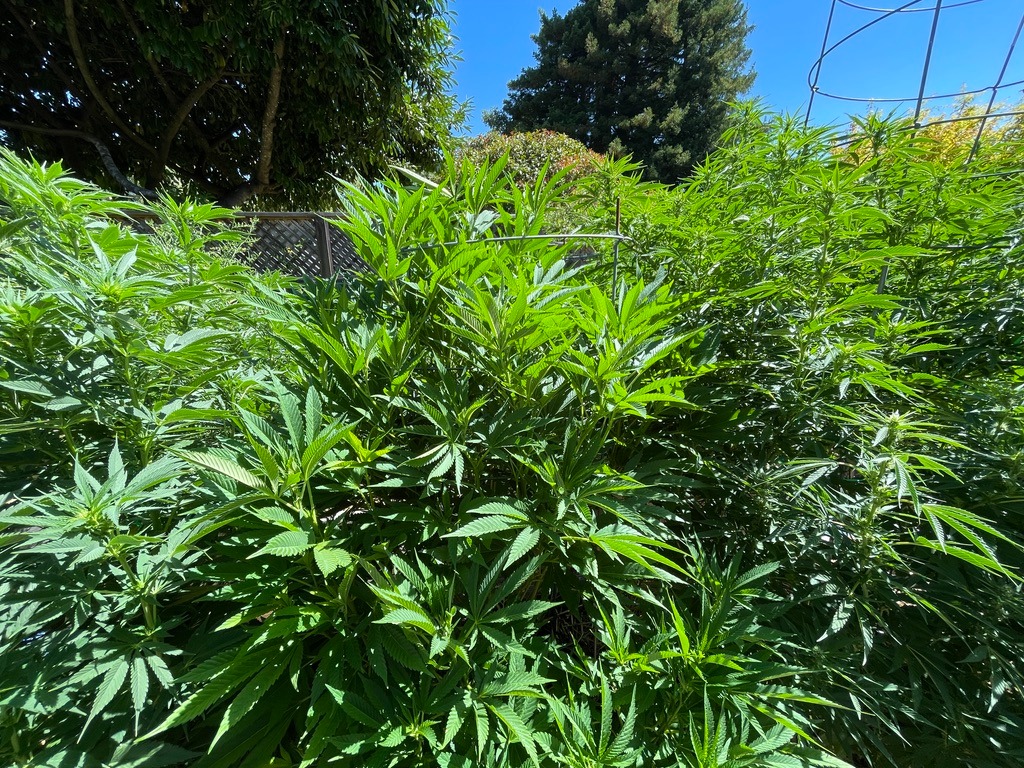
Rośe 21: I look forward to photographing her once the plants around her have been harvested.
Rośe 21 is a wonder to me. I did not know this cultivar could grow taller than me, but this particular plant has done that. The other Rośe we grew, which has already been harvested, was less than half the size of Rośe 21. She has been squished between WCBG 20 and BP 22 the entire summer. My only regret from this grow is that I wish the two Rośe plants switched places. The small one would have grown fine next to the giants, and the big one would have had more room to spread out in bed 19. But we’ll take whatever we get. This is a favored cultivar from last year, and that’s why we’re growing her again. Both my children and I loved this plant before, so we’re looking forward to a larger supply. An interesting footnote to this is that of all the THC plants I grew last year, Rośe had the lowest score, just a little over 18%. All my others were much higher. Yet, the three of us probably preferred this plant over the more powerful cultivars. That’s just one of the amazing things about cannabis. Strength of THC is only one of three factors in the Entourage Effect. This further validates my belief that the real medicine is in the terpenes.
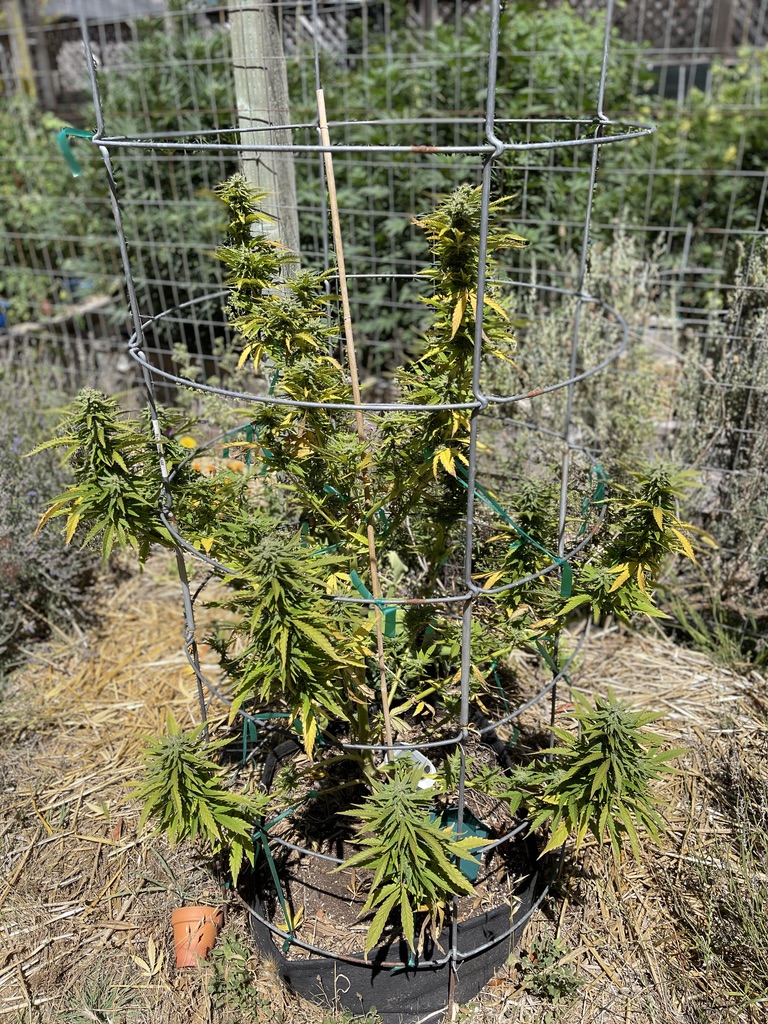
Special Queen 1 is flowering away in her sack, while also not getting water. We cut holes in the bottom of the sack so the roots could potentially meet up with the mycelium below, which appears to have happened. She did not grow as large as I thought she could. It occurs to me that the ground beneath the sack did not have as many years receiving compost teas as my beds. It might take a few years before that location takes off. I’m a patient man. I’ll keep trying.
The White CBG grown in a sack is drying in the cottage, as is Rośe from bed 19, the smallest plant in the beds. So the cottage is fragrant. All the larger plants are still developing, some still in their early stages, while others, like both Banana Papaya, are over a month into growing. As such, the flowers are connecting to each other and soon, all growing will cease on the plants, except for the fattening of the flowers. Right now, to be within the scent radius of these plants, is to understand the joy of proximity.
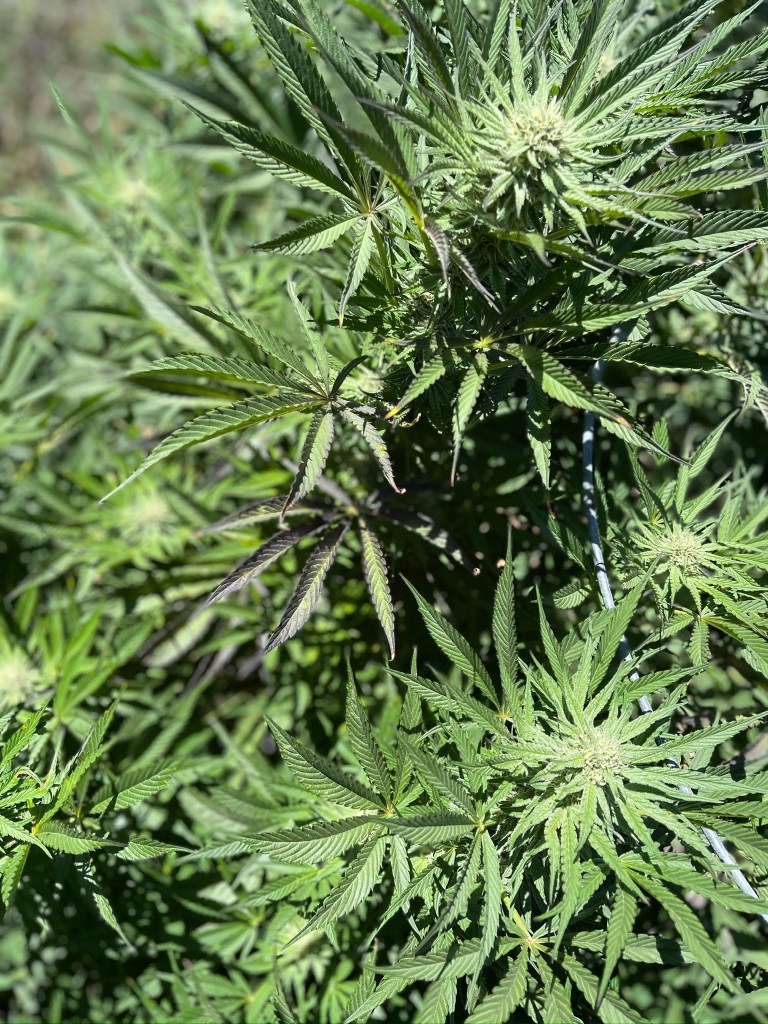
Some years ago, when my crop was in a state of bloom similar to now, I overheard one neighbor talking to another neighbor. She said, “This is the skunkiest smelling place I’ve ever lived.” Of course, many skunks do live here and spraying is not unusual. But the odor my neighbor was describing was not animal in origin, it was plant.
The same level of odor, or perhaps just a bit more, is how my beds smell today. Terpenes aplenty are emerging, and picking out any single terp odor is a challenge. When dealing with ten plus pounds of potential harvest, the odor is a rich conglomerate of everything growing out there. Cannabis, flowers, other plants and various fruits all abound at the moment. Terpenes are not only on the cannabis.
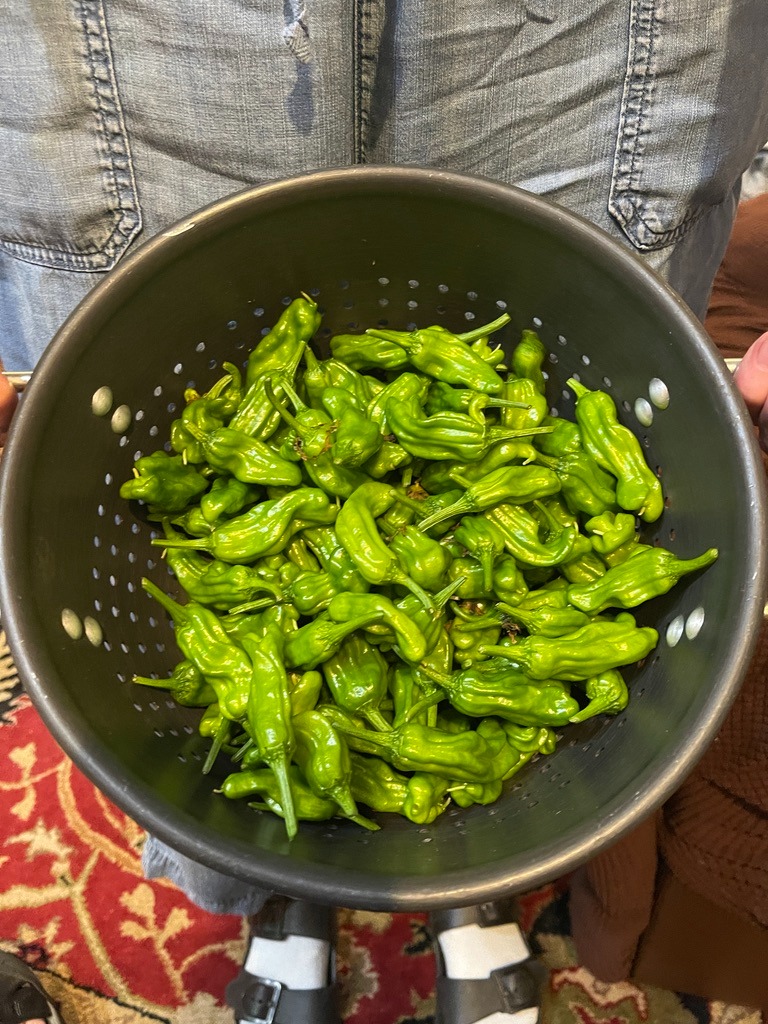
This is about three large servings of shishitos in one pick. Many more to come.
Shishitos and tomatoes are being picked almost daily, not only for consumption, but also to encourage each plant to produce more. They are also being picked early to keep them from being enjoyed by rodents.
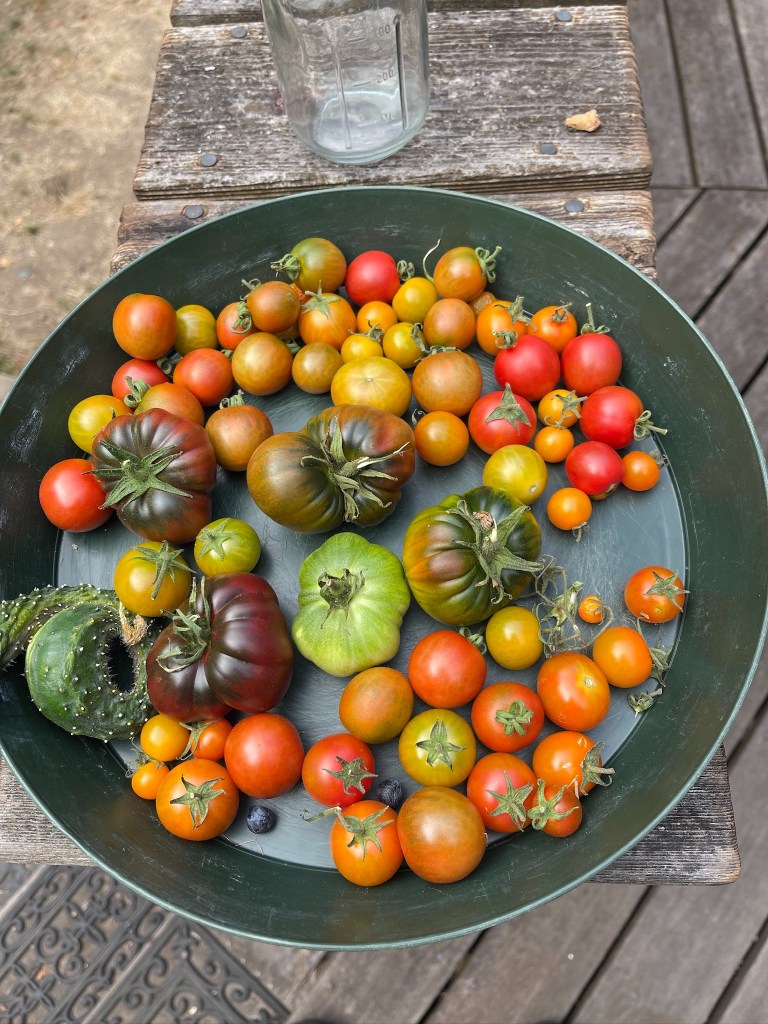
Tomato harvest is just beginning.
We have an annual fight with the local vermin. We set humane traps, drown what we catch, and carry the remains up the hill for distribution amongst other local critters. The crows line up on branches and wait for me when they see that the cages are occupied.
I take no pleasure in killing anything. But I will not tolerate vermin in my medical garden. Sorry.
So we’re picking tomatoes early, because if you wait and let them ripen on the vine, you’re liable to walk out there one morning and find all of your fruit is gone. It has happened before. But by harvesting early, as soon as each tomato shows any hint of color, you save the fruit. It tastes just as sweet when harvested early and allowed to ripen inside. Doing it this way is also a good way of teaching yourself about when each cultivar is really ripe.
Picking early is also an excellent time for me to dust off my Fried Green Tomato recipe. I’m a Northern Californian born and raised, but my early cuisine was mostly southern.
We’ve also begun the annual consolidation of mason jars. Because it’s not only going to be a larger cannabis harvest. We’re also going to be canning and saving various foods. For example, we’ll roast and store poblanos for use over winter. We’re going to make a lot of pesto and freeze it in ice cube trays (serving size).
A quick reminder here–All mason jars do not weigh the same. There is no uniformity to those jars. They can vary in weight by almost 200 grams. This matters if a grower wants an accurate harvest weight. When I first wrote about this years ago, I heard from a grower in Germany. He re-weighed everything in his closet and verified that what I wrote was true.
One extremely encouraging aspect to this grow is the lack of powdery mildew. Bee and I have only seen a single leaf with the white powder. I think there is a connection between this scarce amount of powdery mildew and a technique we tried for the first time this spring.
If you recall, before putting the plants into beds, we dug the holes and drenched them with foliar sprays of both Regalia and Stargus. This idea came from one of the engineers at Marrone Bio Innovations, the people who originally invented Regalia and Stargus. They contend that if you soak the growing medium just prior to planting, the roots of the plant will uptake the Regalia and Stargus, which theoretically should contribute to a much stronger resistance to pathogens. Rather than just foliar spraying like I’ve always done, allow the roots to drink the fluids and spread it systemically through the plant.
We have seen almost no more powdery mildew, even though we’ve had days of high humidity, conducive to pathogenic activity. Only one small leaf and flower were removed. And no mold so far on any of the large plants. I’ll be doing that pre-plant spray from now on.
The first plant to harvest was WCBG (grown in the sack) and she produced 64 grams of popcorn. The 2026 harvest has begun. Full harvest details next month.
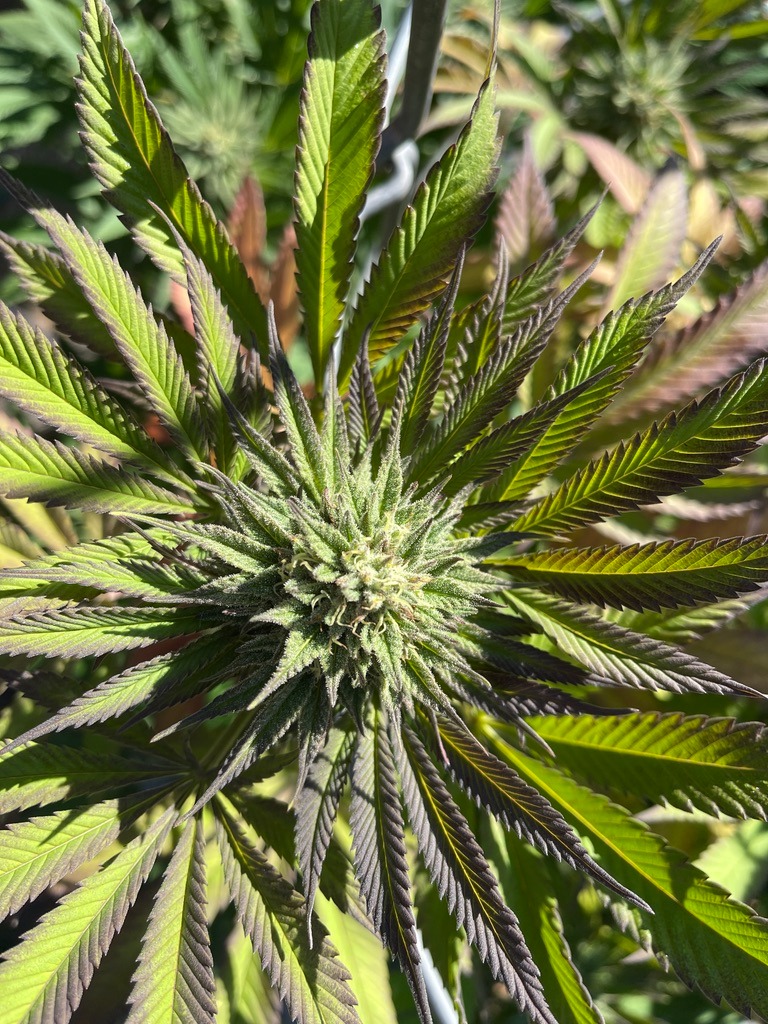
Rośe from last year.
Survive and Vote.
Hey Friends: If you’d like to support jeffreyhickeyblogs.com, please feel free to contact me directly with your ideas (good seeds are always welcome–and if I grow them, I will get the flowers tested and share with you the results.)
Disclaimer: The majority of the links in jeffreyhickeyblogs.com posts are affiliate program links. This means that (most of the time) when you purchase a product linked from my site, I receive a commission, which helps support the blog.


Leave a Reply